
In 2020–2021, the COVID-19 pandemic transformed not only everyday life but also the stock market. While traditional industries faced restrictions, companies involved in e-commerce, remote work, digital entertainment, and home fitness experienced a surge in demand. Some of their stocks multiplied in value within just a few months.
In financial markets, this trend became known as the Stay-at-Home Trade — a strategy focused on companies benefiting from people spending more time at home.
However, once restrictions were lifted, companies followed very different paths. Some experienced declining sales, others retained their new customers but could no longer sustain their previous growth rates, while others found additional sources of growth. According to Financial Times estimates published in May 2024, 50 large companies whose shares had risen particularly sharply in 2020 collectively lost around $1.5 trillion in market capitalization compared with the end of that year.
What happened to the pandemic-era market darlings, and what can their experience teach us amid today's enthusiasm for artificial intelligence?
Why stocks surged and what changed after the pandemic
The pandemic dramatically accelerated digitalization. Consumers increasingly shopped online, businesses shifted to remote work, and education and entertainment moved onto digital platforms. In just a few quarters, some companies attracted as many new customers as they had previously expected to gain over several years. Investors assumed these new consumer habits would persist and that companies could sustain exceptionally high growth rates. Low interest rates and increased retail investor participation provided further support for share prices. The situation changed in 2022. As economies reopened, consumer spending began returning to its previous patterns, while demand growth for many digital services slowed. At the same time, the US Federal Reserve began aggressively raising interest rates, putting additional pressure on the valuations of high-growth companies.
Remote work
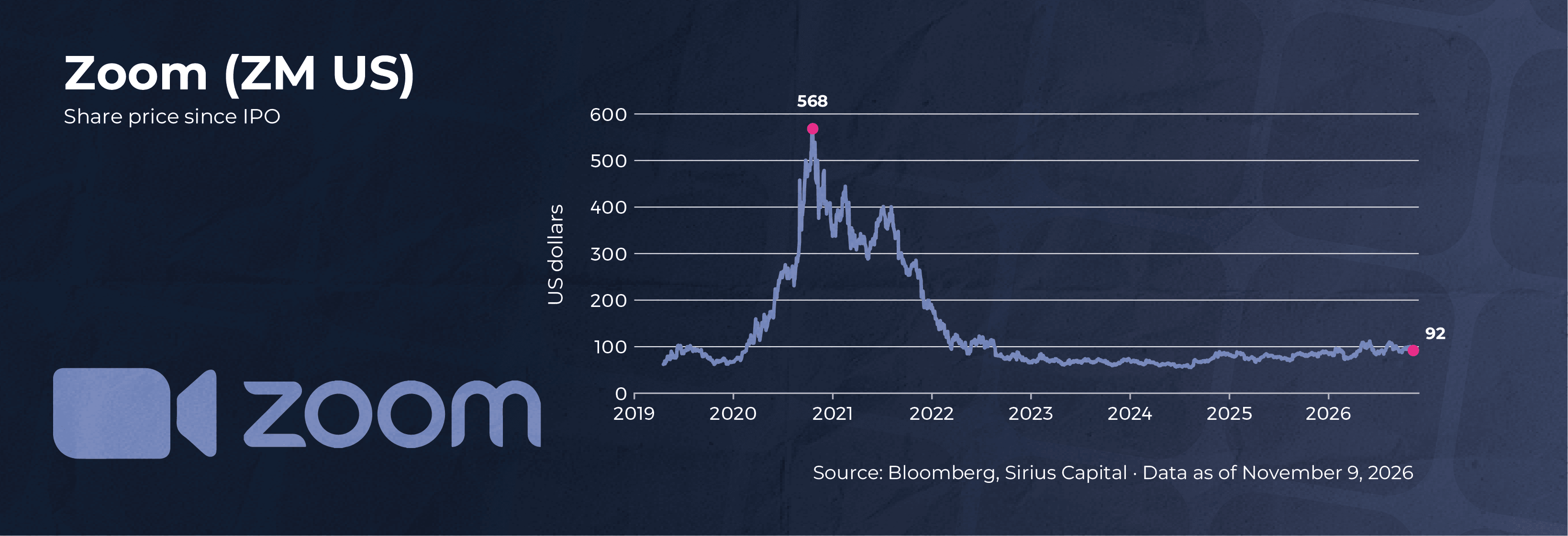
Zoom (ZM US) became one of the most recognizable symbols of the pandemic. In the quarter ended July 2020, its revenue more than quadrupled year over year, while its shares reached an all-time high that October.
However, as employees returned to offices, the company's growth slowed sharply. Competition from Microsoft Teams added further pressure. By 2026, Zoom remained profitable, but its shares were trading approximately 80% below their pandemic peak. The company shifted its focus toward enterprise communications and AI-powered tools.
DocuSign (DOCU US) experienced a similar valuation reset after benefiting from the rapid adoption of electronic signatures. However, growth slowed once the initial wave of digitalization had passed. RingCentral (RNG US) and Twilio (TWLO US) also faced the challenge of finding new revenue streams and improving profitability.
Digital communications thus remained an essential part of business operations, but expectations for their continued pace of adoption had proved overly optimistic.
E-Commerce
The pandemic sharply accelerated the shift to online shopping, but the subsequent performance of e-commerce companies varied considerably.
Shopify (SHOP US) was among the biggest beneficiaries of retail digitalization, with revenue rising 86% in 2020. Following a slowdown in 2022, the company reduced costs, abandoned its ambitious in-house logistics expansion, and refocused on its commerce platform. In Q3 2026, revenue increased 32% year over year.

Etsy (ETSY US), which benefited from increased demand for handmade products and protective masks, experienced slower sales growth after the pandemic. Wayfair (W US) saw its surge in furniture and home goods purchases turn into a prolonged downturn, as many consumers had already upgraded their homes during lockdowns.
Sea Limited (SE US) followed a different path: while its gaming division experienced a normalization in demand, its Shopee e-commerce platform continued to expand. Amazon (AMZN US), MercadoLibre (MELI US), and Chewy (CHWY US) also retained a significant share of the advantages gained from the expansion of online shopping.
Online education
The shift to remote learning sharply increased demand for online education platforms. However, this sector experienced some of the most severe consequences after the pandemic.
Shares of Chegg (CHGG US) reached approximately $115 in early 2021. Growth slowed as students returned to in-person learning, while the emergence of ChatGPT introduced direct competition for paid homework-help services. In May 2023, Chegg's shares lost nearly 50% in a single trading session, and its revenue declined 39% in 2025.

Coursera (COUR US) also faced a reassessment of growth expectations but continued expanding its professional and corporate education offerings, merging with Udemy in 2026. Duolingo (DUOL US), by contrast, succeeded in expanding its user base through gamification and paid subscriptions, although it later faced new challenges from AI. Meanwhile, 2U went through bankruptcy proceedings in 2024 and became a private company.
Chinese education companies represent a separate case. TAL Education (TAL US), New Oriental (EDU US), and Gaotu (GOTU US) suffered primarily from China's regulatory overhaul of after-school tutoring in July 2021, rather than from the end of the pandemic.
Video games and streaming
Lockdowns boosted audiences for video games and streaming services. At Roblox (RBLX US), user spending on the platform, measured by bookings, increased 171% from 2019 to 2020. After the pandemic, the company focused on retaining users and improving monetization, but faced another slowdown in user spending growth in 2026.

Unity (U US) also experienced slower growth in the gaming and advertising markets, while major publishers — Activision Blizzard (now part of Microsoft), Electronic Arts, and Take-Two (TTWO US) — continued developing their businesses through popular franchises and new releases.
Netflix (NFLX US) provides a notable example from the streaming industry. Following a sharp increase in subscribers during the pandemic, the company reported a decline in 2022, triggering a roughly 35% plunge in its share price in a single day. Netflix subsequently returned to growth through an advertising-supported subscription tier and restrictions on account sharing. Roku (ROKU US) faced monetization challenges, while Spotify (SPOT US) gradually shifted its focus toward profitability and subscription revenue.
Home fitness and home improvement
During lockdowns, consumers actively purchased exercise equipment, sportswear, and home improvement products. However, a significant portion of this spending represented purchases that would otherwise have been made later.
One of the clearest examples is Peloton (PTON US). In January 2021, its market capitalization exceeded $40 billion. Expecting demand to remain strong, the company expanded production, but sales slowed after gyms reopened. Layoffs, restructuring, and a sharp decline in its share price followed.

In fiscal 2026, Peloton reported its first annual net profit and reduced net debt by 80%, although its subscriber base continued to shrink. Another home fitness equipment manufacturer, BowFlex, faced even more severe consequences: the company filed for bankruptcy in 2024, and its assets were acquired by Johnson Health Tech.
Home Depot (HD US) and Lowe's (LOW US) benefited from increased spending on home renovations, but demand for do-it-yourself home improvement products slowed after the pandemic. Lululemon (LULU US) gained momentum from rising sportswear sales and acquired Mirror, a manufacturer of interactive home fitness mirrors, for approximately $500 million in 2020. However, the venture failed to meet expectations: Lululemon recognized an impairment charge and discontinued sales of the devices in 2023.
Telehealth
The pandemic dramatically accelerated the adoption of telehealth, but not all new users continued relying on virtual consultations once restrictions were lifted.
Shares of Teladoc (TDOC US) reached approximately $308 in February 2021. Subsequently, demand growth slowed, competition intensified, and expensive acquisitions resulted in substantial asset impairments.
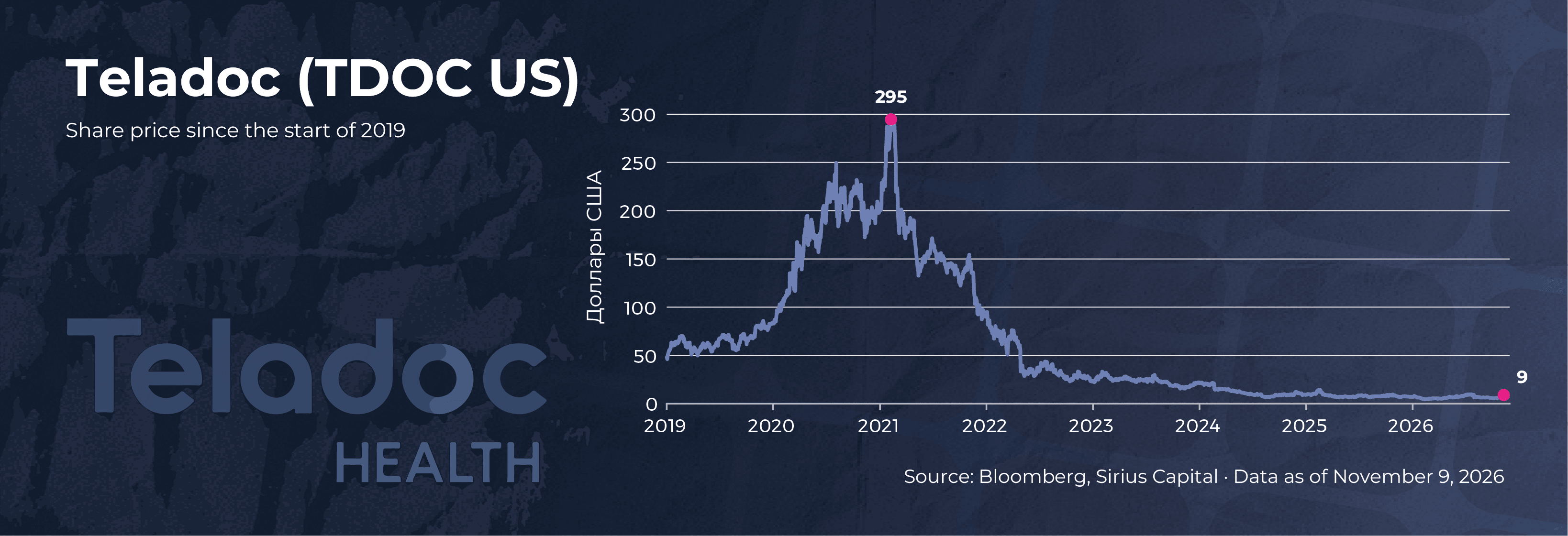
Amwell (AMWL US) also experienced a normalization in virtual consultation volumes. Meanwhile, Hims & Hers (HIMS US) and Doximity (DOCS US) developed under different business models, with performance more closely tied to their own products and monetization strategies.
Delivery services
Some companies managed to turn the influx of customers during the pandemic into a foundation for continued growth.
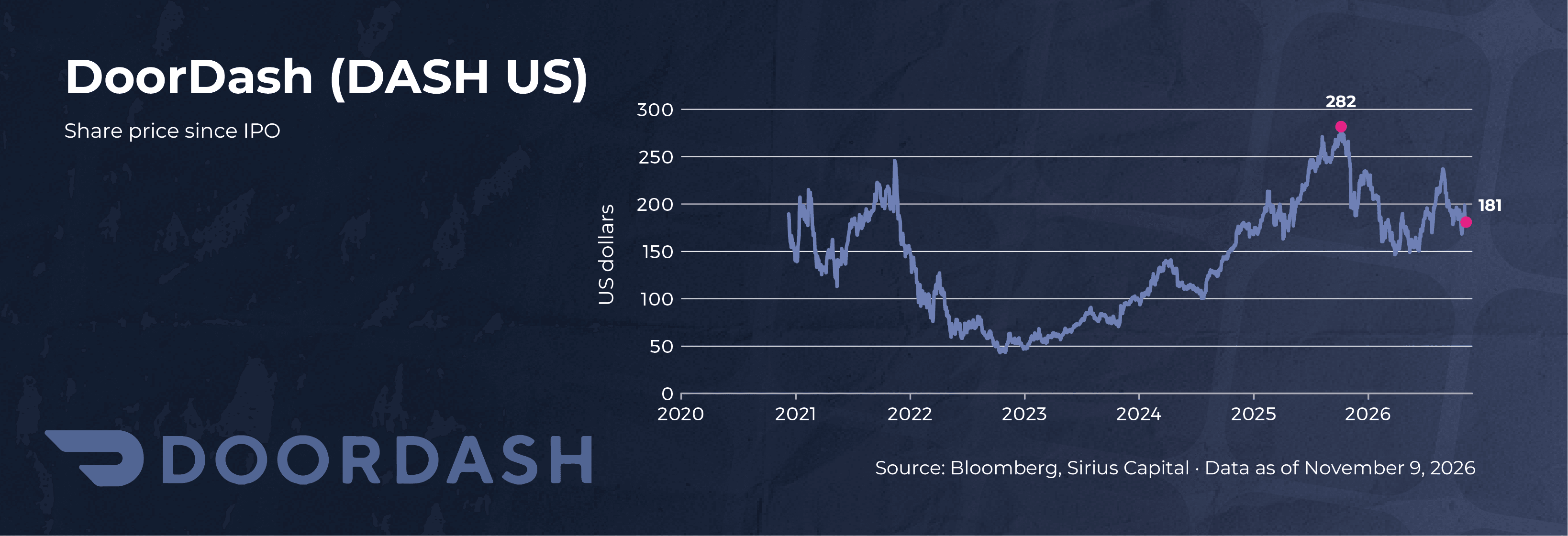
DoorDash (DASH US) rapidly expanded its operations during lockdowns and retained a significant share of demand after the pandemic. It broadened its range of services and entered new markets. In 2025, the company joined the S&P 500 index.
For Uber (UBER US), the pandemic simultaneously created a crisis in ride-hailing and accelerated the development of Uber Eats. Once restrictions were lifted, the recovery in passenger trips complemented the expansion of its delivery business.
Vaccines and diagnostics
For Moderna (MRNA US) and BioNTech (BNTX US), developing COVID-19 vaccines generated unprecedented revenue growth. Moderna's shares approached $500 in August 2021. However, demand fell sharply after mass vaccination campaigns ended, forcing both companies to seek new sources of growth.

By 2026, both companies had significantly expanded their research pipelines. Moderna received approval for an influenza vaccine and reported positive Phase III trial results for a personalized cancer vaccine being developed with Merck. BioNTech shifted its focus toward oncology, advancing several promising treatments into late-stage clinical trials. However, these new developments had not yet replaced revenue from COVID-19 vaccines.
Novavax (NVAX US) shifted toward partnerships and licensing its proprietary Matrix-M technology, including the joint development of a combined influenza and COVID-19 vaccine with Sanofi.
Meanwhile, diversified companies such as Abbott (ABT US) were able to offset declining COVID-19 testing sales through growth in other healthcare businesses, including medical devices and diagnostics.
How market valuations changed
Following the pandemic, many companies experienced declines not only in their share prices but also in their valuation multiples — measures of how much investors are willing to pay for a unit of expected earnings.
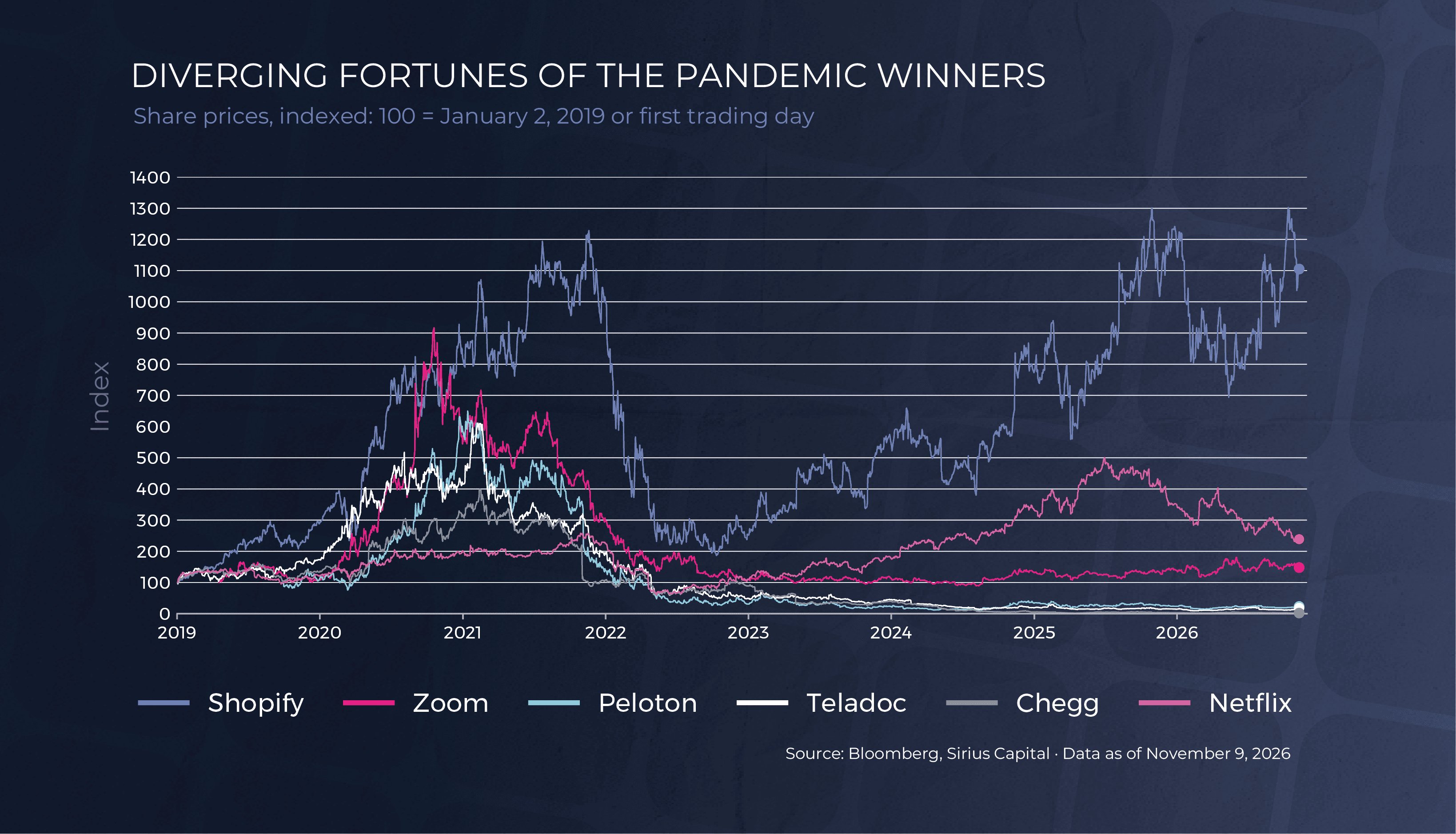
Even companies that maintained resilient businesses faced valuation resets. For example, Shopify continued growing revenue and improving profitability, but the market was no longer willing to pay such a high premium for its future growth. At Zoom and DocuSign, multiple compression coincided with a sharp slowdown in growth, while Peloton also experienced declining demand for its core products.
The repricing therefore reflected not only changes in financial performance but also a reassessment of expectations. In many cases, investors mistook a temporary acceleration in demand for a sustainable growth trajectory. As demand normalized, earlier forecasts became difficult to achieve, while elevated pandemic-era comparison bases further weakened year-over-year performance. Rising interest rates amplified these effects.
The main lesson of the pandemic boom
By 2026, former pandemic darlings found themselves in very different circumstances. Chegg and Teladoc faced persistent structural challenges. Peloton and Wayfair focused on reducing costs and improving profitability despite continued demand pressures. Shopify, Netflix, and DoorDash managed to retain a significant share of their new customers and continue expanding through additional sources of growth.
The pandemic boom demonstrated that a surge in demand does not necessarily translate into sustainably higher growth rates. For some companies, the pandemic provided an opportunity to expand their customer base and strengthen their market positions. For others, it encouraged excessive investment based on what ultimately proved to be temporary demand.
Even companies that continued to grow saw their valuations fall. During the pandemic, investors were willing to pay exceptionally high prices for businesses associated with the Stay-at-Home trend. But as the excitement faded and market attention shifted elsewhere, investors became less willing to pay such high premiums. Valuation multiples declined, sometimes even when companies continued to deliver strong financial results.
The key lesson is that the market can correctly identify a long-term trend while overestimating how quickly it will develop and how much profit individual companies will generate. Even a successful business may prove to be a disappointing investment if its shares were initially priced too high. Against the backdrop of today's enthusiasm for artificial intelligence, this experience is particularly relevant.