
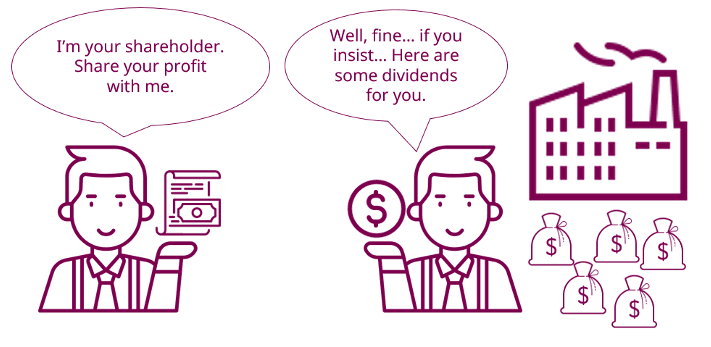
 Dividends are a portion of a company’s profits paid to shareholders as a reward for the capital they’ve invested. The decision to pay a dividend is usually made by the company’s board of directors, which sets the amount, timing, and form of payment (most often cash, less often stock). Dividends are one of the ways a company returns value to its shareholders.
For investors, an important gauge is the dividend yield, calculated as the annual dividend per share divided by the current market price per share. For example, if a company pays $3 per share over a year and the stock trades at $100, the dividend yield is 3%. Companies might pay dividends once a year, twice a year, or more frequently, but dividend yield is typically quoted on an annual basis (unless stated otherwise).

Dividend levels are influenced by the company’s profits, free cash flow (FCF), leverage, and business stability. Typical dividend yields in a given region can depend on the central bank policy rate, inflation, and the pace of economic growth. When interest rates are high, fixed dividend–paying stocks may become less attractive because investors can earn comparable yields on bonds. In developed economies, the average dividend yield for large-cap stocks generally ranges from 2% to 4%.
A high dividend yield does not always mean a “good deal.” A yield that is much higher than the market average can be associated with higher risk. Investors should assess the company’s long-term outlook, its leverage, and its ability to cover dividend payments with profits and cash flows over time.
Most public companies have an official dividend policy, usually available on the investor relations section of the company’s website. The basis for calculating dividends is often (but not always) net income. For example, the payout ratio is a financial metric showing what share of profits the company pays out as dividends:

In practice, the board always considers whether the company has sufficient free cash flow (FCF) to support dividends and evaluates its leverage. Many dividend policies include constraints—target leverage levels, debt covenants, liquidity requirements, and credit-rating considerations.
Not all companies pay dividends, but that does not make them unattractive investments. For example, fast-growing firms often prefer to reinvest profits in development, R&D, and acquisitions and mergers. Dividends are also commonly limited at companies with high leverage or those in a heavy investment phase.
When receiving dividends, be mindful of taxation: the issuer’s country may apply a withholding tax, and your country of residence may apply its own rate—sometimes granting a credit for foreign tax under applicable tax treaties.
The dividend process involves several key dates that investors should understand.

- Declaration date. The date on which the board of directors approves the dividend, specifying the per-share amount, the record date (the date by which shareholders must be on record to receive the dividend), and the payment date.
- Ex-dividend date. This date falls one to two business days before the record date (depending on the settlement cycle). If you buy the stock on or after the ex-dividend date, you will not receive the announced dividend.
- Record date. The date on which all holders of record become entitled to the dividend on their shares.
Why distinguish between the ex-dividend date and the record date? There is a settlement period between the trade date and the date you legally become the owner of the shares—e.g., T+2 (trade date plus two business days). The record date is when the company determines the list of shareholders eligible for the dividend. The ex-dividend date is the first day on which a buyer will not make it onto that list because a purchase on that day will not settle in time for the record date.
- Payment date. The date on which the dividend is actually paid to holders of record.
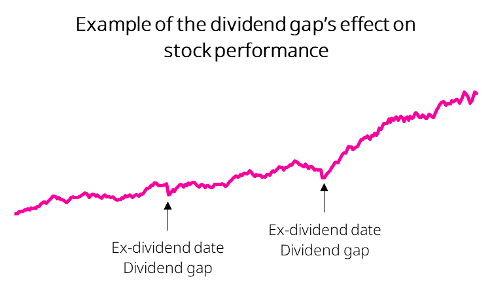
On the ex-dividend date, all else equal, the stock price may decline from the prior close by approximately the amount of the dividend—a technical move known as the dividend gap. For example, if a stock trades at $100 the day before the ex-dividend date and will pay a $3 dividend, buying the day before entitles you to both the share and the $3 dividend on the payment date. Buying on the ex-dividend date entitles you only to the share; the seller receives the dividend. On the ex-dividend date, it is quite possible the share price will drop by about 3%. The dividend gap isn’t inherently dangerous, and its effect typically fades over time—especially if investors expect the company to continue paying dividends in the future.
Besides dividends, companies can return capital through share buybacks—purchasing their own shares on the market. A company may buy back shares to support the price or to signal that management believes the shares are undervalued. Buybacks can also offset the increase in shares outstanding from employee option exercises. In countries where capital gains are taxed at lower rates than dividends, shareholders may prefer buybacks. However, if buybacks occur at inflated prices or are debt-funded, they can destroy value. Many companies combine a stable base dividend with flexible, periodic buybacks.