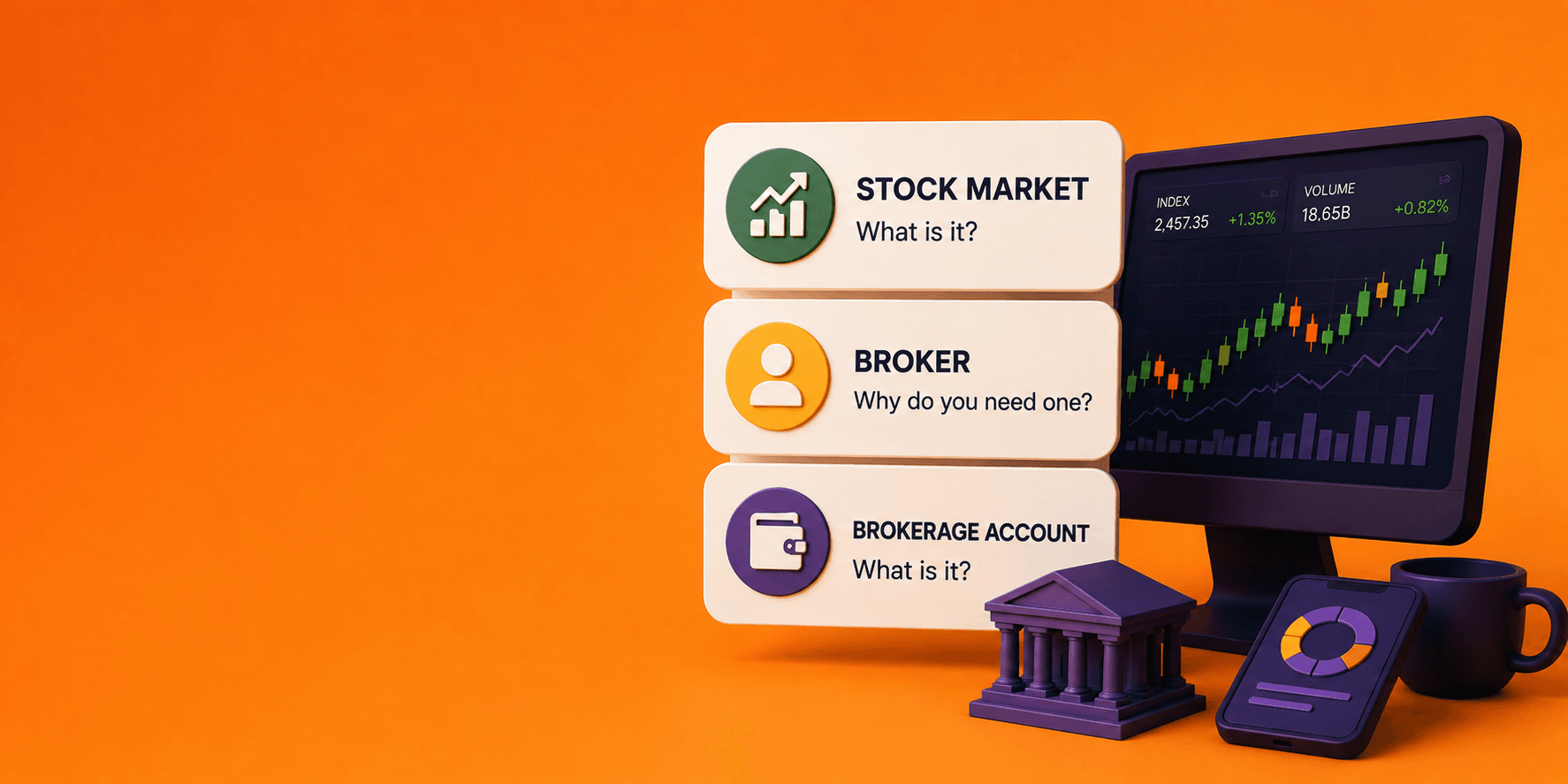
What is the stock market? When you think of the stock market, you might picture scenes from Wall Street movies—serious people surrounded by dozens of monitors, incomprehensible red-and-green graphs... something complex and risky.
However, the stock market can be a useful tool to protect your savings from inflation (i.e. rising prices) and even grow them further. So, let’s break it down.
The stock market is a place where buyers and sellers come together to trade securities, or in other words, assets (like stocks or bonds). For an investor to buy or sell a desired asset, their order goes through several organizations—professional participants in the securities market. These organizations ensure transactions are executed smoothly between millions of investors worldwide.
Among these professional participants are stock exchanges, brokers, depositories, clearinghouses, and other entities. A stock exchange is a specialized platform where people execute trades and exchange money, goods, or securities. It’s somewhat like a marketplace, where securities play the role of goods. Trading on an exchange is strictly regulated. For example, in Armenia, the Armenian Stock Exchange operates under the laws of Armenia, the Central Bank of Armenia, and its own rules. Direct trading on exchanges is limited to professional participants, such as managers, brokers, and investment funds. Ordinary individuals cannot trade on the exchange directly, so they delegate this to brokers.
A broker acts as an intermediary between the investor and the stock exchange. The broker receives the investor’s order to execute a trade, submits it to the exchange, and completes the purchase or sale of assets on the investor’s behalf. Brokers also offer services like listing companies on the exchange, conducting research, and providing investment advice. When serving clients, brokers are required to comply with laws and standards. For instance, brokers must verify their clients' identities and the sources of their funds, which is why they request personal information such as passports. This is standard practice.
Sirius Capital, for example, is a broker providing access to trading various securities. Sirius Capital holds a brokerage license from the Central Bank of Armenia.
A clearinghouse guarantees the settlement of payments in transactions and conducts the clearing of payments. To mitigate risks, clearinghouses act as intermediaries between the parties to a trade, meaning that each party settles with the clearinghouse rather than directly with each other. When an investor sells a security on the exchange, they receive funds from the clearinghouse accounts. This ensures that the investor gets the full amount from the sale quickly, even if there’s a delay in the buyer's payment.
Once the clearinghouse processes the payment, it sends this information to the depository. The depository keeps records of ownership rights to securities—who owns what and how much. After receiving the transaction details from the clearinghouse, the depository confirms the transfer of ownership of the security from the seller to the buyer.
To start investing in the stock market, an investor needs to open a brokerage account. A brokerage account is a special account used for trading securities and currencies on the exchange. It is necessary for storing money, executing trades, and receiving dividends or coupons. You can open such an account with a broker, for instance, with Sirius Capital.
Opening a brokerage account with Sirius Capital will be your first step toward exploring the stock market. Stay tuned for more materials where we’ll dive deeper into this topic!