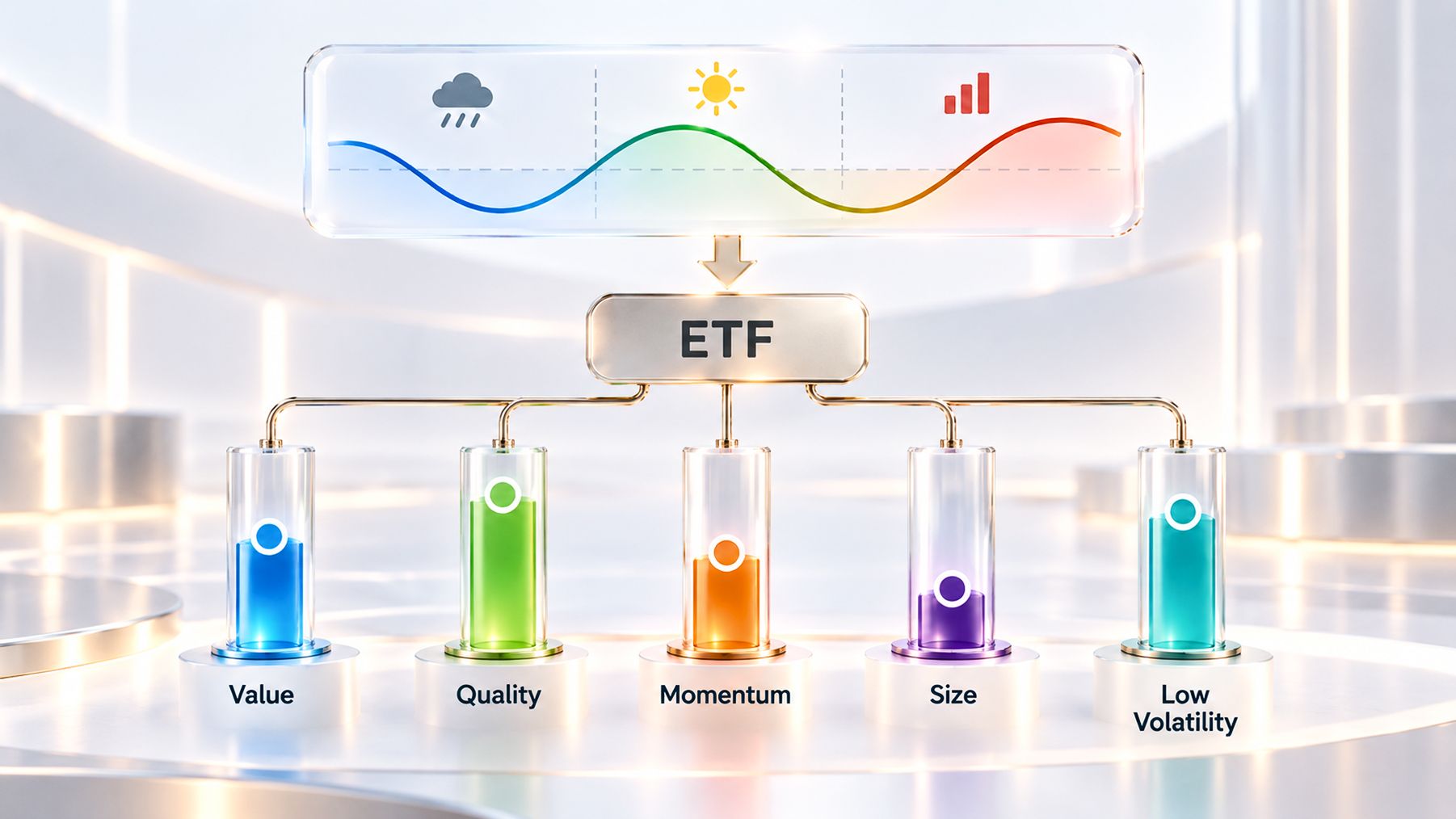
What are Factors?
Stocks can be grouped not only by country or industry, but also by common characteristics. For example, some companies are relatively cheap, others feature high profitability and low debt, while a third group has recently grown faster than the rest. These characteristics are called factors. Investors use them because stocks with similar characteristics often behave in a similar way: under certain conditions, cheap companies perform better; in others, stable and profitable ones do; and in third scenarios, recent market leaders take the lead.

The most famous factors are: Value (relatively cheap stocks), Quality (profitable and financially stable companies), Momentum (recent market leaders), Size (small-cap companies) и Low Volatility (stocks with lower volatility). A factor ETF allows you to invest in a group of such companies all at once. Based on predetermined rules, it selects stocks with the desired characteristic or increases their weighting in the portfolio.
Value: a bet on relatively cheap companies

A Value ETF seeks out companies whose stocks look inexpensive relative to their earnings, assets, or cash flows. This factor often wins during the economic recovery phase. As conditions improve, investors begin returning to companies that previously lagged behind and thus remained relatively cheap. Economy recovers → Profits grow → Interest in previously undervalued companies returns → Value gains an edge. Value can also perform well when the economy continues to grow despite elevated inflation and high interest rates. In such an environment, investors often place higher value on companies that are already generating profits and cash flows today During a deep recession, the situation can be the reverse: many cheap companies belong to cyclical sectors and suffer more severely from an economic downturn. Example of such an ETF: iShares MSCI USA Value Factor ETF (VLUE).
Momentum: a bet on trend continuation
A Momentum ETF buys stocks that have recently grown faster than others, counting on the strong trend to persist for some time. This strategy works particularly well when the economy is growing confidently and there are clear market leaders. A good example from recent years is the artificial intelligence boom: AI-related stocks grew faster than the broader market, and inflows of new capital supported their further growth. Leaders emerge → Investors keep buying them → Growth continues → Momentum wins. However, this factor has a vulnerability. If market sentiment abruptly changes and yesterday’s leaders begin to drop, Momentum can very quickly turn from one of the best strategies into one of the worst. This risk becomes especially high after a prolonged period of growth when too many investors are concentrated in the same popular stocks. Example of such an ETF: iShares MSCI USA Momentum Factor ETF (MTUM).
Quality: a bet on financially stable companies
A Quality ETF focuses on profitable companies with resilient financial results and a relatively low debt load. During strong market rallies, such companies do not necessarily become market leaders: investors are willing to take on more risk and actively buy stocks with higher growth potential. However, when the economy starts to slow down and earnings prospects become less certain, financial stability becomes far more important. Growth slows → Uncertainty rises → Investors become more cautious → Demand for quality companies grows. Therefore, Quality has historically performed especially well during periods of economic slowdowns and market declines. Example of such an ETF: iShares MSCI USA Quality Factor ETF (QUAL).
Low Volatility: a bet on calmer stocks

A Low Volatility ETF selects stocks whose prices typically fluctuate less than the market as a whole. During periods of strong growth, this factor often lags behind: investors are willing to take risks and prefer faster-growing securities. But when the market begins to fall, the situation changes. Risks rise → Investors reduce risk → Calmer stocks hold up better. This does not mean a Low Volatility ETF will rise during a crisis. It still consists of equities and can decline—its drops are simply often less severe. Therefore, this factor should be viewed primarily as a way to make an equity portfolio more stable, rather than a strategy for maximizing returns. Examples of such EFs: iShares MSCI USA Min Vol Factor ETF (USMV), Invesco S&P 500 Low Volatility ETF (SPLV).
Size: a bet on small companies

The Size factor bets on small-cap companies. They are more dependent on the state of the economy and access to financing, making them usually more vulnerable during a downturn. On the flip side, after a recession ends, small companies can benefit particularly strongly: demand recovers, business conditions improve, and investors are once again willing to take on more risk. Economy exits downturn → Conditions improve → Small companies recover faster → Size gains an edge. Size is primarily a bet on economic recovery and is not a defensive strategy. Example of such an ETF: iShares MSCI USA Size Factor ETF (SIZE).
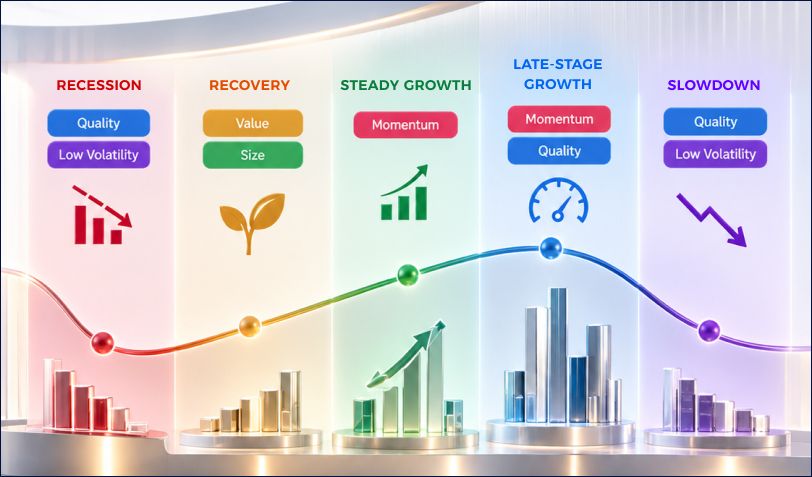
Is it possible not to choose factors manually?
Yes. There are multifactor ETFs that automatically shift emphasis between factors depending on the state of the economy and the market. For example, the Invesco Russell 1000 Dynamic Multifactor ETF (OMFL) identifies the current regime of the economy and market—recovery, expansion, slowdown, or contraction—and shifts its focus among Value, Momentum, Quality, Size, and Low Volatility accordingly. The iShares U.S. Equity Factor Rotation Active ETF (DYNF) uses a more active approach: its model also reallocates the portfolio among factors as market conditions change. Such funds allow investors to avoid trying to time the transition from one factor to another on their own. However, even here there is no guarantee that the model will correctly identify the phase of the cycle or detect its change in time.