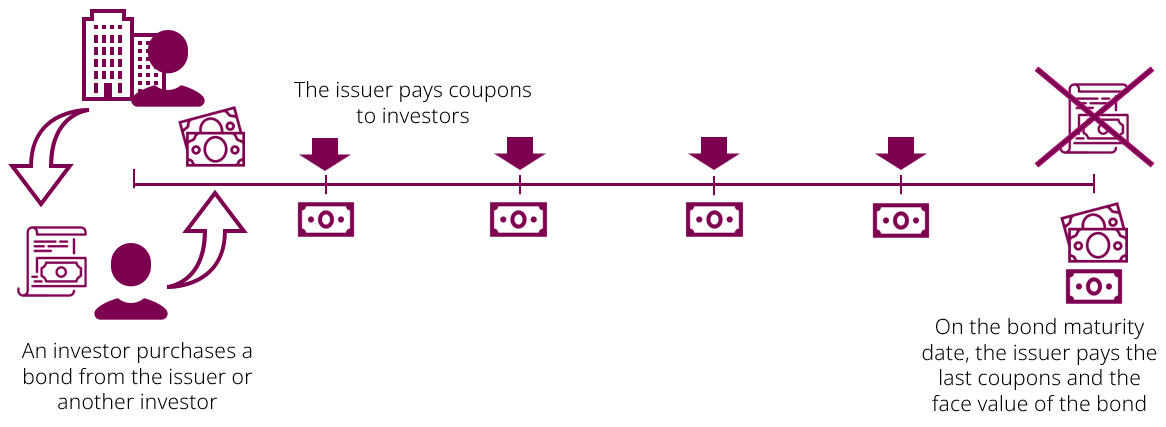
A bond is one of the fixed-income instruments and represents debt investments. When bonds are issued, investors, by purchasing them from the issuer, essentially provide capital to the bond issuer. The value of a bond at issuance is called its nominal value (or face value, or par value). The issuer is obligated to repay this face value with interest—usually in the form of regular coupon payments expressed as a percentage of the nominal value.
The capital raised is generally used to finance the issuer’s long-term investments. Essentially, bonds serve the same function as loans for issuers. After issuance, investors can resell them on an exchange (or over-the-counter) or hold them until the debt is repaid (at maturity).
Key characteristics of bonds
- The issuer is the legal entity that issues securities in the money market or capital market to finance its operations. Issuers can be international organizations, governments, regions, or companies. Bonds issued by governments (national authorities) are known as sovereign bonds.
- Maturity. The maturity date is the day when the final payment must be made. The remaining time until this date is called the time to maturity.
- Nominal value (face value, par value). This is the amount that will be returned to the investor, usually on the bond’s maturity date.
- Coupon rate and payment frequency. The coupon rate is the percentage of the face value paid to bondholders annually. Some bonds pay coupons once a year, while others pay semi-annually, quarterly, or even monthly.
- Debt seniority. In the event of bankruptcy or liquidation of the issuer, bondholders are paid before shareholders because debt takes precedence over equity. However, not all debts are equal — senior debt has a higher priority than subordinated (junior) debt, making it less risky in terms of credit risk.
Some bonds don’t pay coupons until maturity, known as zero-coupon bonds. These bonds only pay the face value on the maturity date and are therefore sold at a discount to par. Examples of such bonds include USA treasury bills.
Investors may also be interested in bonds with floating rates (floaters or floating rate notes), whose coupon payments depend on the current market interest rate. A floating rate protects investors from rising interest rates, as it allows them to receive a higher yield when coupon rates increase.
Bonds with principal indexing might be a tool for inflation protection. While the coupon rate remains fixed, the principal adjusts upward with inflation or downward with deflation. An example of these is USA treasury inflation-protected securities (TIPS).
Bonds can come with additional options:
- Callable Bonds. These give the issuer the right to redeem the bond early at a fixed price. This option benefits the issuing company by allowing it to reduce its debt cost if market rates have fallen. However, it poses a risk to investors because if rates drop, they may have to reinvest the returned funds at a lower interest rate.
- Putable Bonds. These give investors the right (if they choose) to sell the bond back to the issuer at a predetermined price. This option is advantageous if the bond’s price falls below par or if the next coupon offered by the issuer is too low.
- Convertible Bonds. These grant the holder the right to exchange the bond for a specified number of the issuer’s shares.
Bond yields
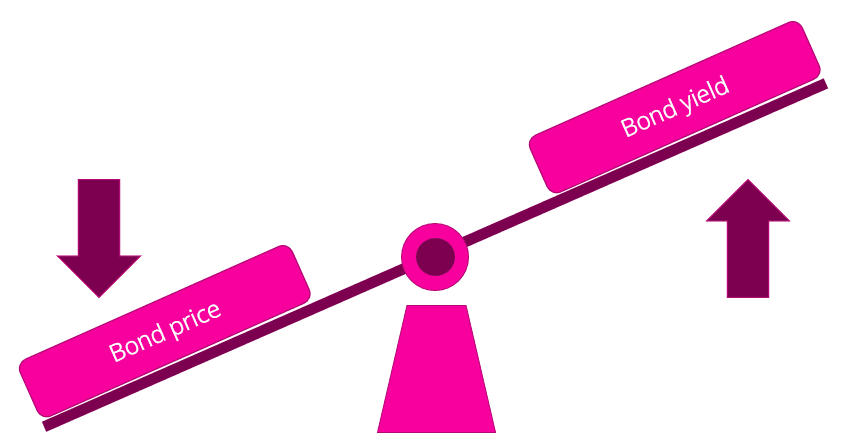
The yield of a bond is determined by its price and the expected cash flows that investors receive from holding it. When a bond’s price falls, its yield rises, and vice versa—thus, there is an inverse relationship between bond prices and yields.
 Most often, when discussing bond yields, the focus is on the yield to maturity (YTM). The yield to maturity indicates the annual percentage return an investor would earn relative to the amount invested if the bond is purchased at its current market price and held until maturity, thereby receiving all coupon payments and the final repayment of the par value.
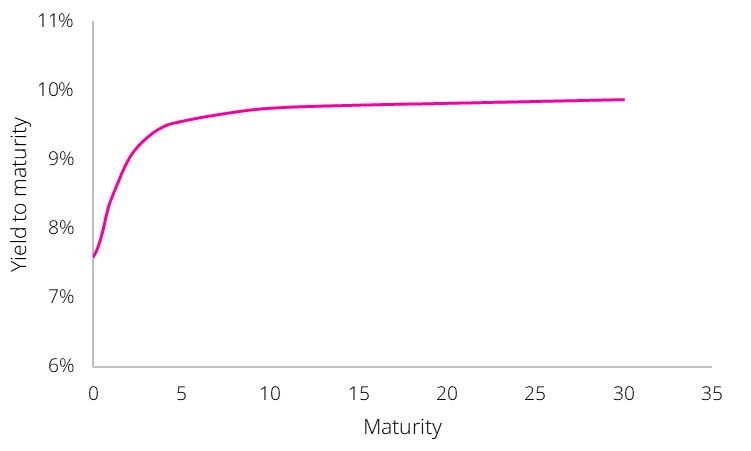
The yield curve illustrates how bond yields vary depending on their time to maturity. Typically, investors demand higher yields for long-term bonds due to future uncertainty, resulting in an upward-sloping yield curve. However, there are instances when the yield curve is downward-sloping (inverted).
Most often, when discussing bond yields, the focus is on the yield to maturity (YTM). The yield to maturity indicates the annual percentage return an investor would earn relative to the amount invested if the bond is purchased at its current market price and held until maturity, thereby receiving all coupon payments and the final repayment of the par value.
The yield curve illustrates how bond yields vary depending on their time to maturity. Typically, investors demand higher yields for long-term bonds due to future uncertainty, resulting in an upward-sloping yield curve. However, there are instances when the yield curve is downward-sloping (inverted).
Armenian government's dram bonds yield curve, as of February 14, 2024
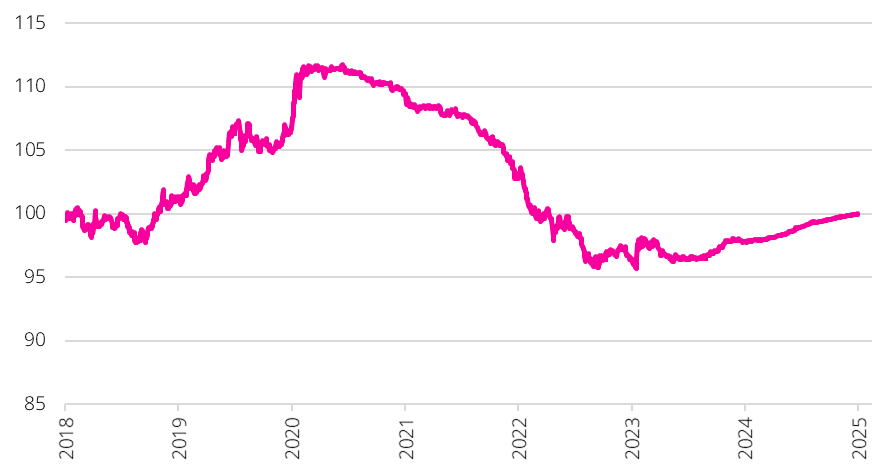
 Before maturity, a bond may trade at a discount or premium to its par value, but as the maturity date approaches, its price tends to converge toward the par value.
Price dynamics of a USA government bond maturing on February 28, 2025. As the maturity date nears, the bond’s price approaches the par value of $100.
Risks associated with investing in bonds
-
Interest rate risk Inflation poses a problem for investors because it reduces the future purchasing power of their savings and investment returns. For example, an investment yielding 2% in an environment with 3% inflation actually results in a negative real return of –1%. Inflation is especially dangerous for bonds since their coupon payments are fixed until maturity; over time, the purchasing power of these payments declines. Moreover, if inflation exceeds a certain level, central banks usually raise interest rates to curb consumer spending, which in turn causes bond prices to fall.
-
Inflation risk Inflation poses a problem for investors because it reduces the future purchasing power of their savings and investment returns. For example, an investment yielding 2% in an environment with 3% inflation actually results in a negative real return of –1%. Inflation is especially dangerous for bonds since their coupon payments are fixed until maturity; over time, the purchasing power of these payments declines. Moreover, if inflation exceeds a certain level, central banks usually raise interest rates to curb consumer spending, which in turn causes bond prices to fall.
-
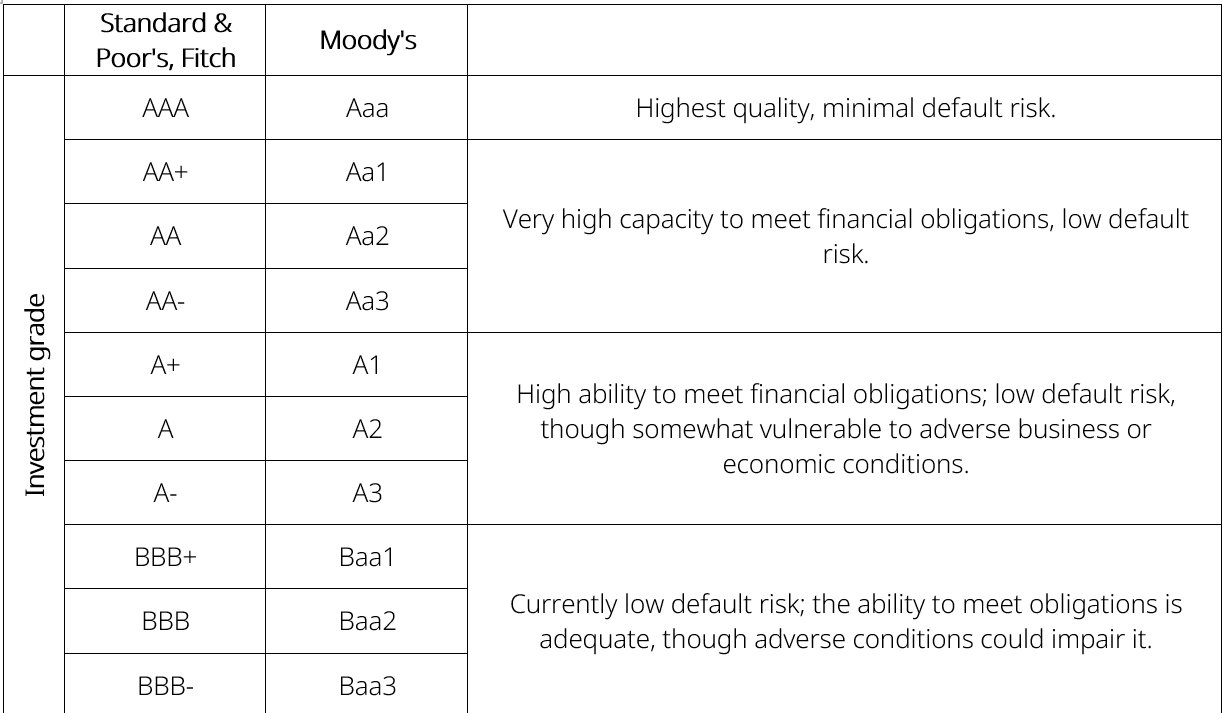
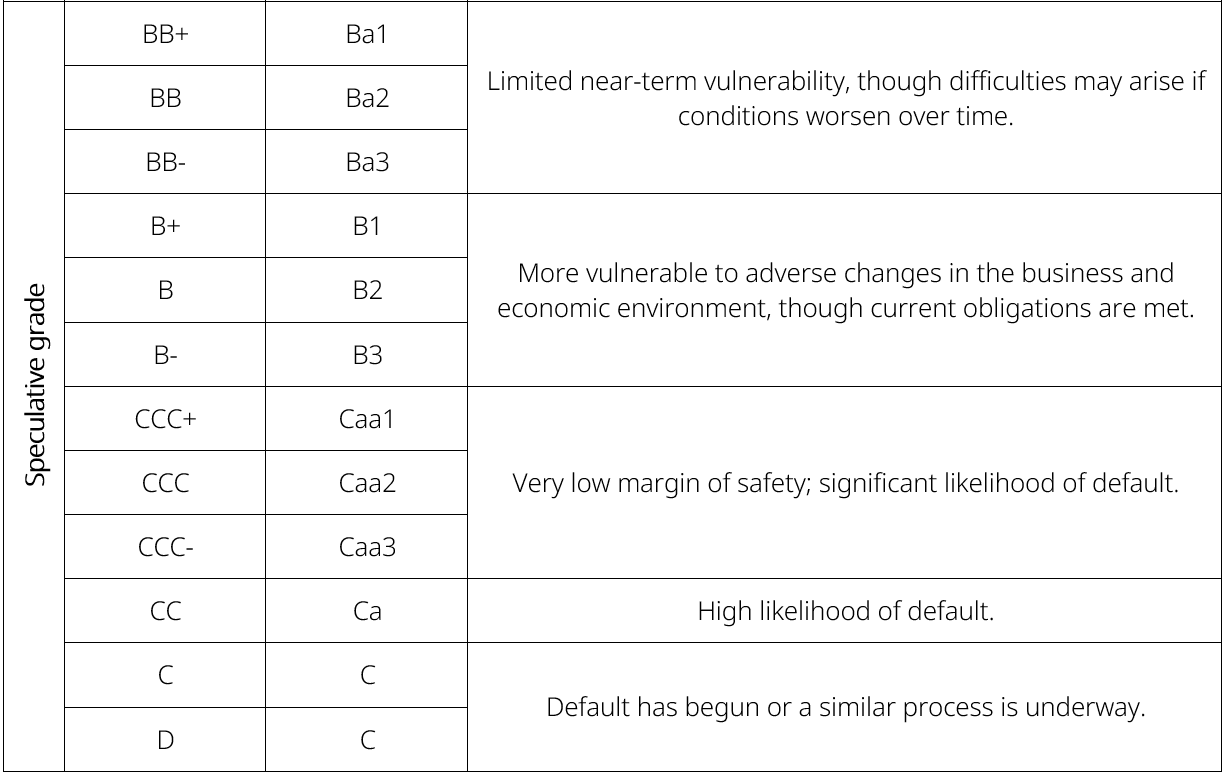
Credit (Default) Risk Every bond carries the risk of issuer default—that is, the risk that the issuer will be unable to pay the interest and principal in full and on time. Independent rating agencies assess the credit risk of bond issuers and publish credit ratings to help investors evaluate these risks. The major rating agencies are Moody’s, Standard & Poor’s, and Fitch Ratings. These agencies assign ratings ranging from D (bonds in default) to AAA (the highest rating, indicating the most reliable bonds) for Standard & Poor’s and Fitch, or from C to Aaa for Moody’s. Based on credit ratings, bonds are generally divided into two main categories:
-
Investment grade. Bonds issued by companies with high creditworthiness, with ratings of BBB and above (for S&P and Fitch) or Baa3 and above (for Moody’s).
-
Speculative grade. Also known as high-yield or “junk” bonds, these have ratings of BB+ and below (S&P, Fitch) or Ba1 and below (Moody’s), indicating lower credit ratings and a higher risk of default. If an issuer’s financial condition deteriorates, its credit rating may be downgraded; conversely, improvements in fundamental indicators can lead to an upgrade.
Credit rating categories
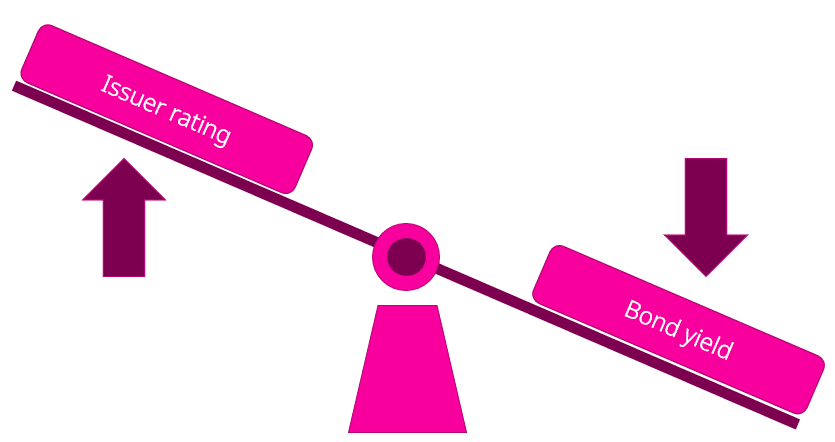
 Ratings affect bond interest rates—a highly rated issuer pays a lower interest rate than a lower-rated issuer. Buying bonds with lower credit ratings can yield higher returns, but the investor assumes increased default risk.
Overall, government bonds from developed countries are considered low-risk investments due to the very low probability of default, whereas government bonds from emerging markets may carry higher risks.
- Reinvestment Risk
When investors receive coupon payments or the return of principal, they may choose to reinvest the money in new bonds. If interest rates have fallen during that time, the new bonds will offer a lower yield. This is known as reinvestment risk. As mentioned earlier, such risk can particularly arise with callable bonds.