
Have you noticed how many electric vehicles (EVs) are on the streets these days? One can’t help but wonder if it’s possible to capitalize on this trend through investments.
According to the International Energy Agency (IEA), global EV sales reached 17 million units in 2024, marking a growth of over 25%. By the end of 2024, the global EV fleet reached nearly 58 million vehicles—about 4% of all passenger cars worldwide and more than 3 times higher than in 2021. Distribution is uneven: in China, around one in ten cars is electric, while in Europe it's closer to one in twenty.
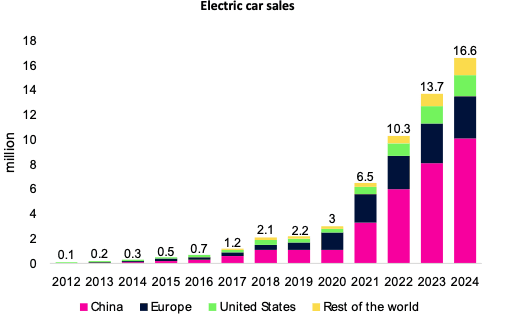 Source: IEA, Sirius Capital
Many governments are implementing subsidy programs to encourage EV adoption and achieve environmental targets. These initiatives are part of broader climate change policies aimed at reducing greenhouse gas emissions and transitioning to sustainable transportation.
Today, EVs often offer a lower total cost of ownership compared to internal combustion engine (ICE) vehicles, primarily due to lower fuel and maintenance costs. EV affordability has significantly improved over the past decade, driven by falling battery prices, increased competition, and economies of scale. In 2024, despite a small increase in average battery capacity, the average global battery pack price dropped by over 25% compared to 2023, leading to a reduction in EV production costs and retail prices.
The IEA expects global EV sales in 2025 to grow by another 25%, just like in 2024, surpassing 20 million vehicles sold globally. While sales could be impacted by economic instability and policy shifts, more than one in four cars sold in 2025 is expected to be electric.
In 2024, China remained the largest EV market and the top EV exporter. Global EV exports surged by nearly 20%, reaching around 3.2 million vehicles. China accounted for approximately 40% of global EV exports, or nearly 1.25 million vehicles.
Chinese EV manufacturers
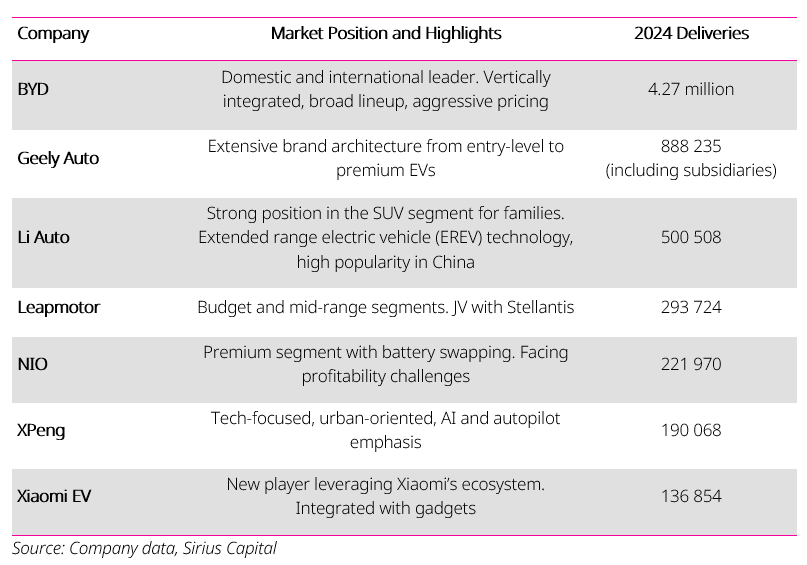
Changes in tariff policies across various regions are making it more difficult for Chinese electric vehicles (EVs) to remain competitive in key markets. In 2024, several regions introduced new import duties on Chinese EVs. These additional export-related costs are prompting Chinese automakers to establish production facilities abroad. The planned assembly plants are aimed both at supplying local markets directly (for example, BYD's plant in Brazil) and at exports, in order to mitigate risks associated with rising import tariffs on goods from China (such as BYD's plant in Turkey for exports to the EU). Europe and Southeast Asia are likely to remain the primary regions for the placement of such assembly facilities.
At the same time, the gradual phase-out of subsidies is leading to a decrease in the share of government spending in the EV market, while overall global consumer spending on EVs is increasing (i.e., the significance of subsidies in EV purchases is declining).
So, which securities (apart from the well-known Tesla TSLA) can you invest in to participate in the growth of the electric vehicle market? Automakers
- BYD (1211 HK)
- Geely Auto (175 HK)
- Li Auto (LI US/2015 HK)
- Leapmotor (9863 HK)
- NIO (NIO)
- XPeng (XPEV US/9868 HK)
- Rivian (RIVN)
Charging Infrastructure
Battery and Materials
- Albemarle (ALB) – Produces a wide range of lithium compounds used in batteries for EVs and consumer electronics
- Contemporary Amperex Technology (3750 HK) – Battery manufacturer
ETFs offering EV exposure. Ideal for investors seeking diversified or targeted exposure without picking individual stocks:
- Global X Autonomous & Electric Vehicles ETF (DRIV)
- Global X Lithium & Battery Tech ETF (LIT)
- iShares Self-Driving EV and Tech ETF (IDRV)
When investing in stocks related to electric vehicles (EVs), the main risks may include:
-
Geopolitical risks, such as the introduction of restrictions on the import of Chinese cars. There is a global trend toward tightening conditions for Chinese automakers, especially in the United States, Canada, and the European Union. However, in a number of countries, they are successfully establishing themselves and capturing a significant share of the market.
-
Regulatory risks. The cancellation of support for EV sales and the construction of charging stations in the United States may negatively affect demand for electric vehicles in the region.
-
Competition. In May 2025, shares of automotive companies declined when BYD announced large-scale discounts.
-
Technology and environmental standards are constantly evolving. If companies fail to keep up with these changes, they may lose their competitive advantages.
Invest with Sirius Capital!