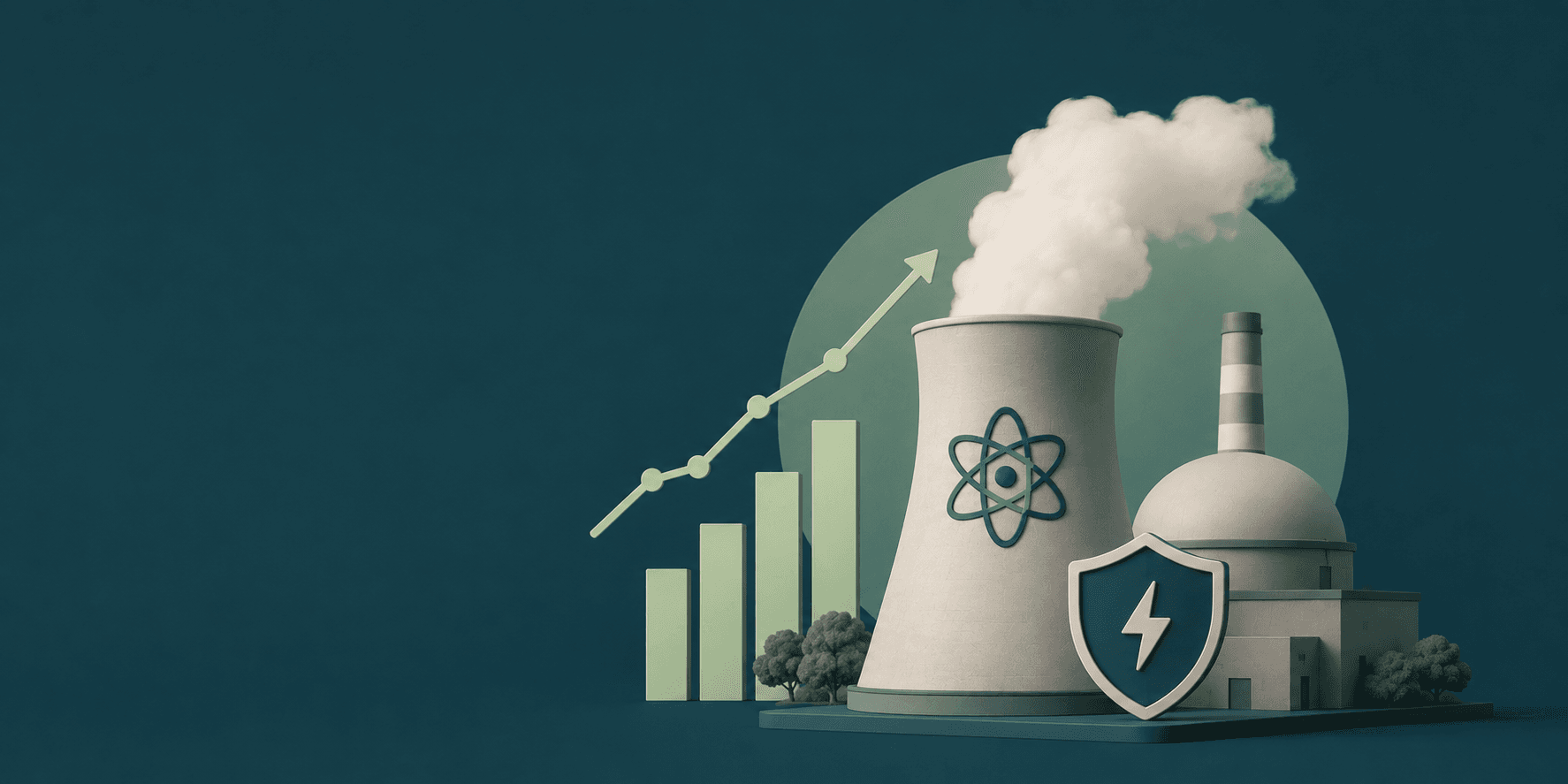
Nuclear energy can be an attractive long-term investment idea. It is one of the few sources of reliable, around-the-clock, carbon-free power generation, demand for which has surged due to the data center boom and the rise of artificial intelligence (AI). A rare alignment is emerging where political and climate agendas and the commercial interests of the world's largest technology companies are together creating long-term structural demand for this type of energy.
The development of AI requires enormous amounts of electricity. Data centers need power 24/7 — highly reliable and ideally with minimal environmental impact. According to the IEA, data centers already consume more than 4% of electricity in the United States, and by 2030 this figure is projected to more than double to 426 TWh, with data centers accounting for nearly half of the country's total electricity demand growth over that period. Solar and wind energy can serve as sources of new clean capacity, but their intermittency creates challenges for facilities that require continuous power.
Against this backdrop, technology companies are increasingly turning to nuclear energy as one possible source of clean baseload generation — alongside natural gas, which still dominates the energy mix of most data centers. Technology giants such as Amazon, Microsoft, Meta, and Google are signing large-scale, multi-year power purchase agreements (PPAs) to secure their energy future.
- In March 2024, Amazon Web Services (a subsidiary of Amazon) acquired a data center from Talen Energy and entered into a power supply agreement from the Susquehanna nuclear plant in Pennsylvania. In June 2025, Talen expanded the deal: the new PPA provides Amazon with 1,920 MW of carbon-free nuclear energy through 2042, with a phased ramp-up to full capacity no later than 2032.
- In September 2024, Constellation Energy announced the signing of its largest-ever 20-year power purchase agreement (PPA) with Microsoft, aimed at restarting Unit 1 of the Three Mile Island nuclear plant in Pennsylvania to supply Microsoft's data centers with carbon-free energy.
- In October 2024, Amazon invested more than $500 million in small modular reactor development: the company invested in SMR developer X-energy and separately entered into an agreement with Dominion Energy to explore the feasibility of building an SMR near their North Anna nuclear plant in Virginia.
- In October 2024, Google announced a power purchase agreement with SMR developer Kairos Power, with the first reactor expected to come online by 2030.
- In June 2025, Meta signed a 20-year contract with Constellation Energy to offtake the full 1.1 GW of output from the Clinton nuclear plant in Illinois starting in 2027.
- In January 2026, Meta signed agreements with Vistra, TerraPower, and Oklo to power its Prometheus AI supercluster.
It should be noted that uranium and nuclear sector stocks rose sharply in 2024–2025 on the back of AI enthusiasm. Some companies are trading at valuations that already price in very optimistic scenarios. If data center growth slows, AI enthusiasm cools, or cheaper alternatives for powering data centers emerge, a correction in the uranium and nuclear sector could follow.
Energy independence. Recent geopolitical conflicts have exposed Europe's vulnerability to gas dependency. The European Commission identifies SMR-based power generation as a means of achieving energy affordability, decarbonization, and import independence. At the nuclear summit in March 2026, European Commission President Ursula von der Leyen announced new financial support for nuclear projects, describing the phase-out of nuclear energy in recent years as a "strategic mistake."
At the Paris Summit on March 10, 2026, Belgium, Brazil, China, and Italy joined the declaration to triple nuclear capacity, bringing the total number of signatory countries to 38.
Below, we review the securities through which investors can gain exposure to nuclear energy.
Uranium mining and the nuclear fuel cycle
Cameco Corporation (CCJ US). Cameco is the world's largest publicly traded uranium producer, controlling the full cycle from ore mining to fuel fabrication and reactor services. The company mines and processes uranium and provides refining, conversion, and nuclear fuel manufacturing services, supplying a significant portion of the world's reactor fleet. The majority of its revenue is generated in North and South America.
Kazatomprom (KAP LI) is the national atomic company of Kazakhstan and the world's largest producer of natural uranium. It accounts for approximately 20% of global uranium production. Kazatomprom's business model covers virtually all stages of the pre-reactor nuclear fuel cycle.
Centrus Energy (LEU US) is a US company specializing in the supply of low-enriched uranium (LEU) to commercial nuclear power plants. Its core business is the sale of uranium enrichment services (SWU), as well as uranium supply and contract services for the US Department of Energy; the company operates enrichment facilities in Kentucky. Centrus is actively developing gas centrifuge technology under the American Centrifuge project, aimed at establishing domestic US enrichment capacity and reducing dependence on foreign suppliers. Its primary customers are US and international nuclear utilities; its largest market is the United States. Following bankruptcy in 2014, the company underwent financial restructuring and refocused on technology development and strategic cooperation with the government.

NexGen Energy (NXE US). NexGen is a Canadian company building the Rook I uranium mine in Canada — the world's largest undeveloped uranium deposit, located in one of the best uranium districts in the world. The deposit has exceptionally high uranium grades, enabling extraction at very low costs. Investors should understand that NexGen is a pre-revenue company: the mine generates no income yet — first sales are expected only in 2033–2034, and until then the company must invest significant capital in its construction. NexGen Energy is a bet on "premium uranium." If the Rook I project is delivered on time, the company will become one of the world's major players, capable of competing in scale and cost with giants such as Cameco and Kazatomprom.
Uranium Energy (UEC US). One of the fastest-growing uranium mining companies in the US, focused on ensuring the country's fuel independence. The company specializes in environmentally friendly in-situ recovery (ISR) mining and has two production centers ready to operate — in South Texas (Hobson) and Wyoming (Christensen Ranch). It holds the largest uranium resource in North America. In 2022, UEC significantly expanded its asset base by acquiring Canada's Roughrider from Rio Tinto and the company UEX.

Energy Fuels (UUUU US). An American company that owns the only operating uranium processing mill in the United States, while simultaneously pursuing two growing markets: uranium and rare earth elements (REE) needed for magnets, electric motors, and defense technologies. Uranium currently generates the bulk of revenues, but by 2027–2029 the company plans to build a complete rare earth production chain — from raw material extraction in Australia, Brazil, and Madagascar to finished products at its mill in Utah. The company is currently unprofitable as it invests in expanding production capacity. In essence, it is a long-term bet on US energy independence.

CGN Mining (1164 HK). A subsidiary of Chinese state corporation China General Nuclear Power Corp (CGN), focused exclusively on uranium mining investments. The company holds stakes in major producing deposits, primarily in Kazakhstan through joint ventures with Kazatomprom, including Semizbay-U and Ortalyk.
Key Risks
- Commodity price volatility. A sharp decline in global uranium or rare earth prices would reduce business profitability.
- Execution risk. Building new processing lines is a complex undertaking. A delay of one to two years could temporarily weigh on share prices.
- Geopolitical and regulatory risks. Changes in laws, taxes, sanctions, or political instability can undermine the viability of projects.
Power generation companies and plant operators

Constellation Energy Corporation (CEG US) is the largest private operator of nuclear power plants in the United States, with approximately 32 GW of nuclear generation capacity operating at a capacity factor of around 94% — meaning virtually no downtime. Following the acquisition of gas company Calpine in January 2026, the company added another 23 GW of capacity and a retail business serving approximately 59 TWh of annual load. Its business model is built on selling electricity at market prices and through direct long-term contracts with data centers, which pay a significant premium above market rates for guaranteed round-the-clock carbon-free generation. In essence, this is a defensive play: stable cash flow today plus modest but predictable growth as new premium contracts with technology giants are signed.

Vistra Corp (VST US) is a major independent power producer in the United States with a diversified portfolio of nuclear, gas, and renewable assets, as well as a retail business serving millions of customers. The company is aggressively signing long-term nuclear power contracts with data centers — deals with Meta and AWS are already in place — and simultaneously expanding its gas portfolio through the acquisition of Cogentrix.
CGN Power (1816 HK). The largest nuclear power plant operator in China and one of the leaders in the global nuclear industry. The company is a subsidiary of state corporation China General Nuclear Power Group. It operates a fleet of nuclear plants, designs and builds new nuclear capacity, deploys its own third-generation Chinese reactor design — the Hualong One (HPR1000) — and manages the full lifecycle of nuclear facilities.
Key Risks
- Regulatory risk. The nuclear industry is one of the most heavily regulated in the world. License renewals for existing reactors are not guaranteed, permits for new construction take years to obtain, and a change in political direction — as seen in Germany and Japan — can force the early closure of operating plants.
- Major accident risk. A serious incident anywhere in the world can instantly affect the entire sector, regardless of the country or company involved.
- Competition from renewables. Renewable energy technologies such as solar continue to improve and fall in cost. Battery storage technologies with multi-hour capacity are gradually addressing the intermittency problem of renewable sources.
- Geopolitical risks. Sanctions, political instability, or logistical disruptions can create fuel supply shortfalls.
Advanced technologies and Small Modular Reactors (SMRs)
Traditional nuclear power plants are enormous facilities costing tens of billions of dollars and taking 15–20 years to build. Small modular reactors (SMRs) represent a new generation of nuclear technology designed to solve this problem: reactors of significantly smaller output are assembled at a factory like a kit and delivered to site as finished modules, much like a mass-produced product. The core thesis is that serial manufacturing and standardization will reduce costs and construction timelines, opening nuclear energy to new consumers including industrial facilities and data centers. This is why Google, Amazon, and Microsoft have already signed long-term contracts with SMR developers, betting that the technology will become a reality by the early 2030s. However, no commercial SMR of Western design is yet in operation: most projects remain in development or licensing stages, and the one major US project was cancelled in 2023 due to cost overruns. SMRs are therefore simultaneously the most promising and the riskiest bet in energy: the technology promises much, but its real cost and timeline remain an open question.

Oklo (OKLO US) is an American startup developing compact nuclear reactors with a capacity of 15–75 MW. Its first major customer is Meta, which signed an agreement for 1.2 GW with an upfront payment, though first actual power deliveries are not expected before 2030. The company is pursuing access to government plutonium stockpiles (20 tonnes), which could supply its fuel needs until large-scale HALEU (high-assay low-enriched uranium) production facilities come online in the mid-2030s. An investment in Oklo is a venture bet on the potential growth of the SMR market — though that growth is not guaranteed. The company currently generates no revenue and has no operating energy assets: its market capitalization reflects expectations of future projects rather than existing cash flows. Funding comes from raised capital and customer advance agreements.
NuScale Power (SMR US) is an American small modular reactor developer. Its flagship technology is the VOYGR module, which allows flexible scaling of plant output from 77 MW to 924 MW depending on customer needs. The reactor received standard design approval from the NRC regulator. At the current stage (early 2026), revenue consists of engineering fees and payments under partnership agreements, including with developer ENTRA1 Energy, which takes on capital expenditures and asset management. The strategic focus has shifted to powering data centers and executing the first export project in Romania. The company is currently unprofitable. The launch of the first commercial installation is not expected before 2029–2030.

Nano Nuclear Energy (NNE US). Nano Nuclear Energy's business model is aimed at building a vertically integrated ecosystem around microreactors of up to 20 MW, designed for rapid deployment and autonomous operation. Unlike developers of larger SMRs, the company bets on portability — reactors ZEUS and ODIN — enabling deployment in remote locations, on military bases, and in space. In addition to reactor design, NNE is developing ancillary business lines: HALEU fuel production, fuel transportation services, and consulting, with the goal of becoming a "one-stop shop" for small-scale nuclear energy. The company is in the investment stage, deploying capital toward licensing and the construction of a prototype at the University of Illinois by 2027.
Key Risks
- Technology risk. Many projects in this space are still in development. The real cost of construction, operational reliability, and project economics will only become clear after the first facilities come online — at best in the mid-2030s. Nuclear construction projects can exceed budgets and timelines.
- Financial risk. Companies developing new technologies may burn through cash for years before generating their first revenue. They depend on continuous capital raising, and in the event of deteriorating market conditions or project delays, may face an acute funding shortage.
You can also invest in the nuclear energy sector through a diversified portfolio of stocks from various companies (including those mentioned in this blog) using an ETF. For instance, by purchasing the Global X Uranium ETF (URA US).