
All investments in our lives (even purchases at a store) carry a certain degree of risk: every investment has a chance of loss relative to the expected return on the invested capital. You might buy a pomegranate at the market, come home, peel it, and discover it’s spoiled. Similarly, when investing in the stock market, one must not forget the associated risks.
It is impossible to earn returns on investments without taking on risk. The usual rule is: the lower the risk, the lower the potential return, and the higher the risk, the higher the possible profit. The optimal balance between potential returns and risk depends on your risk tolerance and investment horizon.
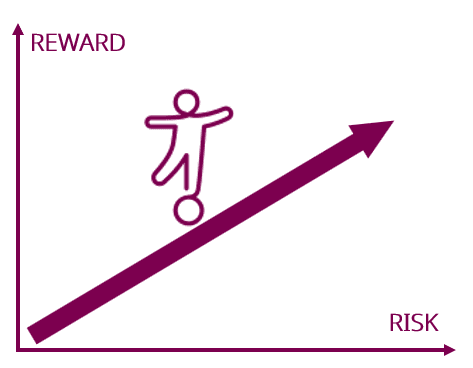
How can we determine how much risk to take? Each investor has unique circumstances and a different level of risk tolerance, but two main factors can help in making a decision:
- Investment horizon. Before investing your funds, it’s important to determine how long they can be invested. For example, if you have $1,000 and will need that money in the short term (say, in a year) for an important purchase, investing in high-risk stocks is not the best idea. With such a short horizon, you might be forced to sell assets when their prices are falling. However, if you can invest that $1,000 for long terms, say, 10 years, you can invest in riskier assets. In the long run, you have more time to recover from potential losses.
- Size of capital. Determine how much money you are ready to lose without causing serious consequences to your financial situation. For instance, a person with $10,000 and another with $1,000,000 will react differently to a loss of $5,000. For one, it might represent half of their savings, while for the other, it’s only 0.5%. Thus, for an investor with less capital, such a loss would be much more significant.
In any case, when investing, you should not immediately commit all your savings or pension. To protect your capital and maintain financial stability, it is important to have a reserve fund covering several months of expenses.

We can consider a collection of investments as an investment portfolio. A portfolio may include various assets such as stocks, bonds, cash, a car, and real estate. Investment risks can be reduced through portfolio diversification. Diversification involves allocating funds among different assets and markets to minimize potential losses and stabilize portfolio returns. The main goal of diversification is to reduce reliance on a single asset or economic sector. If one instrument or sector declines in value, others can compensate for the losses, ensuring overall portfolio stability. As the saying goes, don’t put all your eggs in one basket.
One of the simplest ways to diversify is to invest not in individual stocks or bonds, but in exchange-traded funds (ETFs). An ETF already includes a set of assets, depending on its focus. For example, you can choose an ETF that targets IT sector stocks (Technology Select Sector SPDR Fund), USA stocks (SPDR S&P 500 ETF Trust) or Chinese stocks (iShares MSCI China ETF), high-yield dollar-denominated corporate bonds (iShares iBoxx $ High Yield Corporate Bond ETF), commodities (Invesco Bloomberg Commodity UCITS ETF), or even cryptocurrency (iShares Bitcoin Trust ETF). There is a wide variety of ETFs to choose from.
While diversification within a single asset class is a good idea, allocating capital among different asset classes is even better. In the stock market, different asset classes carry different risks. Understanding the risk levels associated with various asset classes will help you determine which investment products best suit your risk appetite and financial goals.
The Most Common Asset Classes:
- Stocks. When you buy stocks, you purchase a share of a company and gain the right to a portion of its profits (when the company decides to distribute them). Stocks are generally riskier than bonds, but they can offer higher returns.
- Bonds. By purchasing a bond, you lend money to a company or government. In return, the borrower agrees to repay the principal along with interest. Bonds are considered less risky than stocks, but they typically yield lower returns.
- Cash and Deposits. These are the most liquid and least risky assets. However, they either yield no income or offer minimal returns compared to other assets.
- Real estate. Investments in real estate can generate income or appreciate over time. However, maintaining property in good condition may require additional investments, and its liquidity is lower compared to other assets.
Liquidity refers to the efficiency or ease with which an asset can be quickly sold at a market price without significant losses in value. The low liquidity of an asset creates additional risks for investors.
-
Commodities. These include raw materials used in the production of goods and services, such as oil, gold, and wheat. Commodity assets can be volatile but help diversify a portfolio.
-
Derivatives. These are financial instruments (such as futures, options, or warrants) whose value is derived from an underlying asset, such as a commodity, currency, or security. Derivatives can be powerful tools for hedging (reducing risks) and speculation, but they require professional knowledge and risk management. Without proper strategies, they can lead to significant losses, especially when excessive leverage is used.
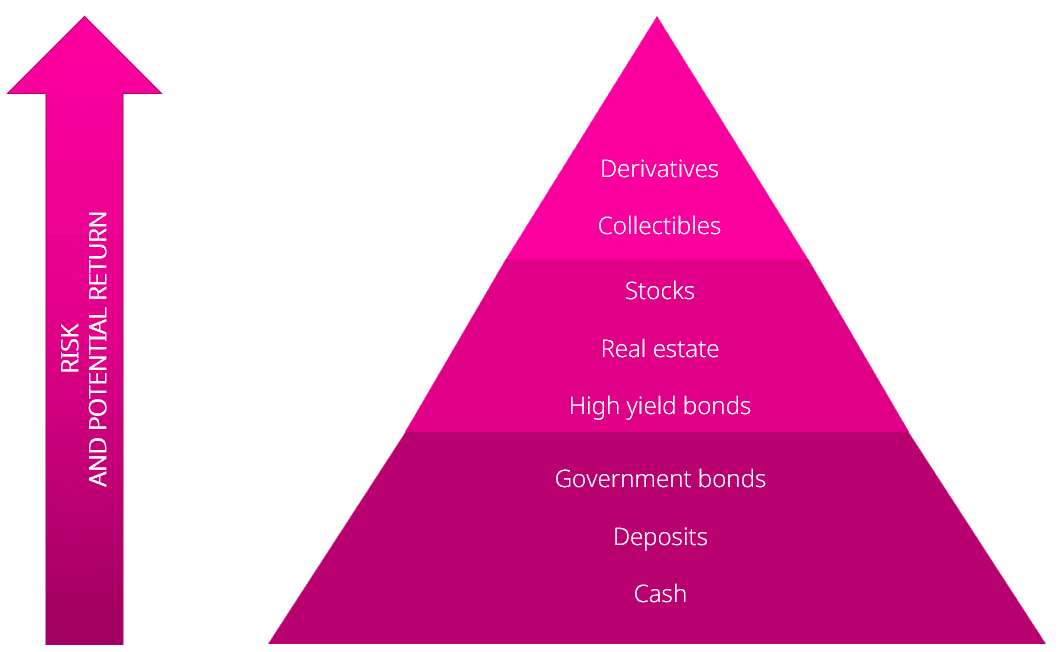
Forming an investment portfolio involves combining various investment assets to maximize returns and minimize risk. It is important to find the optimal balance that aligns with your risk tolerance and financial goals. While it is impossible to completely eliminate investment risks, they can be managed.
Let’s consider a portfolio consisting solely of stocks and bonds. Depending on the investor’s risk tolerance, the allocation between stocks and bonds might look approximately as follows:
 After determining the combination of assets, you can start selecting the specific securities to include in your portfolio. If you are focusing on long-term investments, take into account fundamental structural trends that will have a greater impact on your capital than short-term news, which is more relevant for speculative strategies. Periodically review your portfolio to see how it is performing.
Begin your investment journey with Sirius Capital!