
The USA stock market is one of the largest and most developed in the world, driven by the scale and resilience of the American economy, high liquidity due to the participation of numerous investors, including foreign ones, the USA dollar's status as a global reserve currency, the significant presence of IT companies, and effective regulation.
However, concentrating capital in a single economy carries risks when building an investment portfolio. Diversification is recommended by allocating assets across different geographic regions, as the performance of stock markets in various countries can vary significantly over time. Nevertheless, during periods of global turmoil, such as economic crises, wars or pandemics, all markets might experience negative trends as investors tend to move away from risky assets.
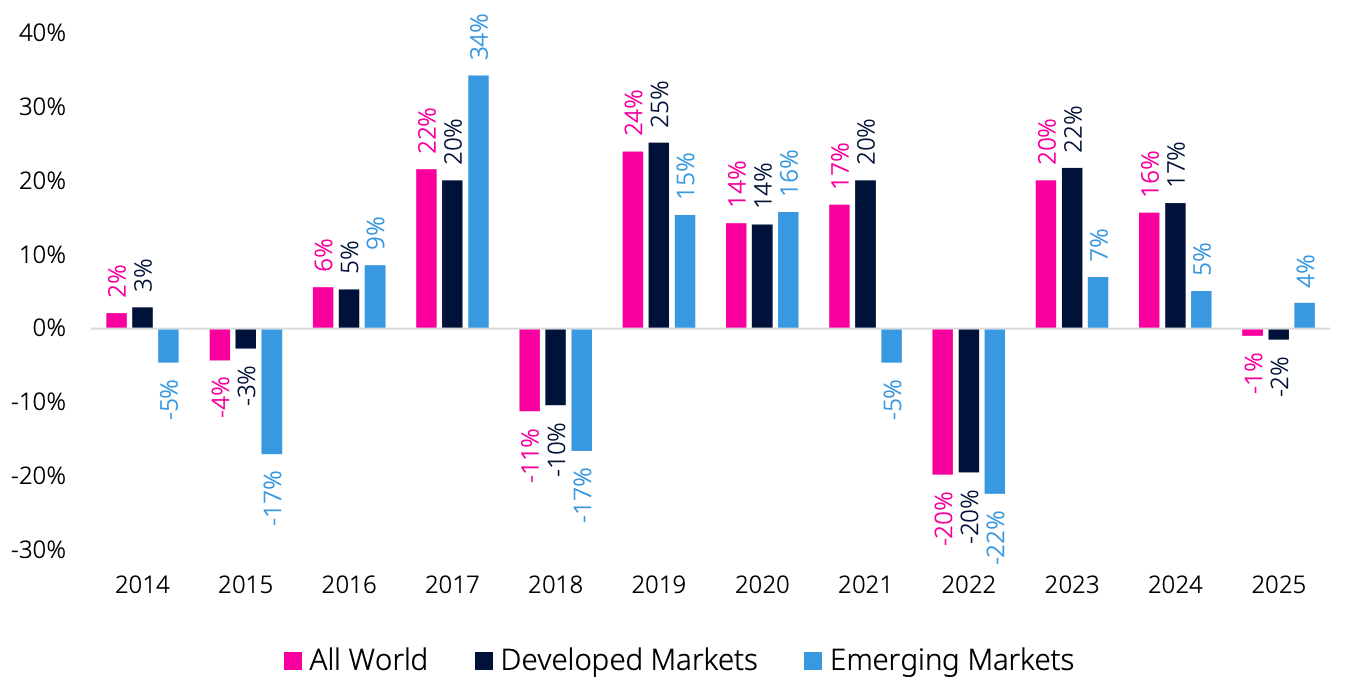
It is worth noting that even in years when markets declined, they subsequently rebounded, with growth offsetting previous losses. Overall, over the past 10 years (up to the end of 2024), developed markets have shown positive performance, averaging an annual increase of 8% in U.S. dollar terms.
Performance of Developed and Emerging Stock Markets in USD (as of March 11, 2025)*
 Source: Bloomberg, Sirius Capital
* Here and below, the MSCI ACWI index was used to represent the performance of the global stock market, MSCI World for Developed Economies, and MSCI Emerging Markets for Emerging Markets. The performance for 2025 is shown from the beginning of the year up to March 11, 2025.
In this blog, MSCI indices are used to represent stock market performance. MSCI indices (Morgan Stanley Capital International) are a group of stock market indices designed to track the performance of equities across various global markets. They are widely used by investors, funds, and analysts to assess market performance, build investment portfolios, and manage risks. MSCI Developed Markets include: Australia, Austria, Belgium, Canada, Denmark, Finland, France, Germany, Hong Kong, Ireland, Israel, Italy, Japan, the Netherlands, New Zealand, Norway, Portugal, Singapore, Spain, Sweden, Switzerland, the United Kingdom, and the United States. MSCI Emerging Markets include: Brazil, Chile, China, Colombia, the Czech Republic, Egypt, Greece, Hungary, India, Indonesia, South Korea, Kuwait, Malaysia, Mexico, Peru, the Philippines, Poland, Qatar, Saudi Arabia, South Africa, Taiwan, Thailand, Turkey, and the United Arab Emirates. Through ETFs (Exchange-Traded Funds) that track the performance of various country indices, investors can gain exposure to stock markets across different countries. Below, we present several such options.
List of ETFs for developed economies
- iShares MSCI World ETF - URTH
- iShares MSCI Canada ETF - EWC
- iShares MSCI Japan ETF - EWJ
- iShares Core MSCI Europe ETF - IEUR
- iShares MSCI United Kingdom ETF - EWU
- iShares MSCI France ETF - EWQ
- iShares MSCI Germany ETF - EWG
- iShares MSCI Switzerland ETF - EWL
- iShares MSCI Netherlands ETF - EWN
- iShares MSCI Spain ETF - EWP
- iShares MSCI Italy ETF - EWI
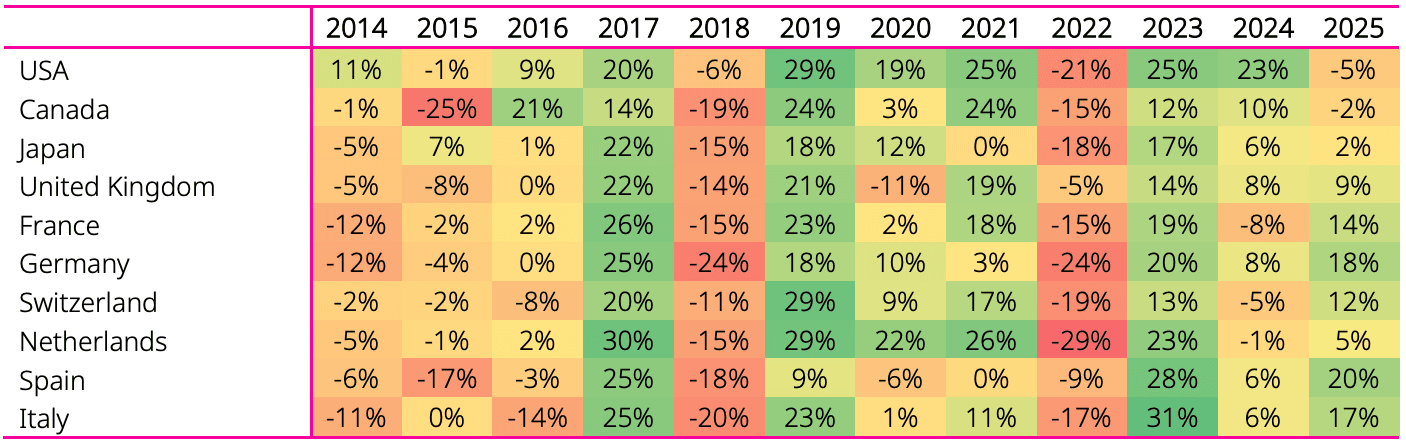
Performance of developed stock markets in USD (as of March 11, 2025)
 Source: Bloomberg, Sirius Capital
List of ETFs for emerging economies
- iShares MSCI Emerging Markets ETF - EEM
- iShares MSCI China ETF - MCHI
- iShares MSCI Taiwan ETF - EWT
- iShares MSCI India ETF - INDA
- iShares MSCI Brazil ETF - EWZ
- iShares MSCI South Korea ETF - EWY
- iShares MSCI South Africa ETF - EZA
- iShares MSCI Saudi Arabia ETF - KSA
- iShares MSCI UAE ETF - UAE
- iShares MSCI Qatar ETF - QAT
- iShares MSCI Poland ETF - EPOL
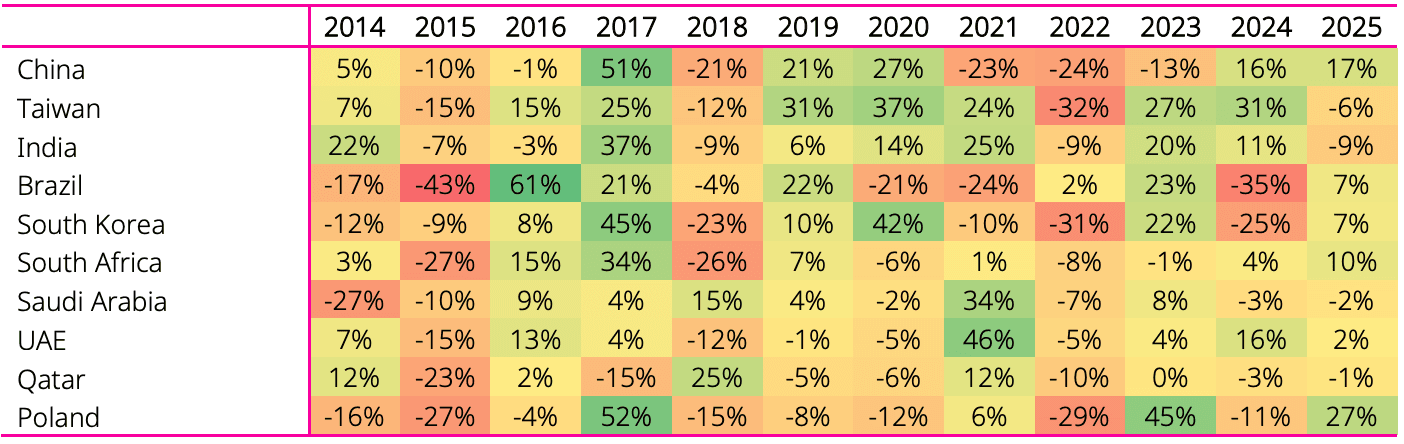
Performance of emerging stock markets in USD (as of March 11, 2025)
 Source: Bloomberg, Sirius Capital