We’ve already covered what a bond is and its key parameters in one of our previous blogs. In this post, we’ll take the next step and explore what you should pay attention to when buying bonds.
Bond Price
In the market, bond prices are quoted as a percentage of their face value. For example, if a bond is quoted at 98 and its face value is $1,000, its price is $980 per bond. In such a situation (when the bond price is below par), the bond is said to be trading at a discount. If such a bond trades at 101, it costs $1,010 per bond and is said to trade at a premium. If a bond trades at 100, it costs $1,000 and is said to trade “at par.”The purchase and sales price of a bond at any given time may differ slightly. In market terms, ask is the selling (offering) price, and bid is the buying price. Ask is the minimum price at which a seller is willing to sell the asset. Bid is the maximum price at which a buyer is willing to purchase the asset. These quotes exist simultaneously, with ask consistently higher than bid. This is logical: buyers want to pay less, and sellers want to receive more. If you want to buy a bond, you primarily look at the ask price. If you want to sell, you look at the bid price.
In the market, bond prices are quoted as a percentage of their face value. For example, if a bond is quoted at 98 and its face value is $1,000, its price is $980 per bond. In such a situation (when the bond price is below par), the bond is said to be trading at a discount. If such a bond trades at 101, it costs $1,010 per bond and is said to trade at a premium. If a bond trades at 100, it costs $1,000 and is said to trade “at par.”The purchase and sales price of a bond at any given time may differ slightly. In market terms, ask is the selling (offering) price, and bid is the buying price. Ask is the minimum price at which a seller is willing to sell the asset. Bid is the maximum price at which a buyer is willing to purchase the asset. These quotes exist simultaneously, with ask consistently higher than bid. This is logical: buyers want to pay less, and sellers want to receive more. If you want to buy a bond, you primarily look at the ask price. If you want to sell, you look at the bid price.
It is important to understand that if an investor holds a bond until maturity, they receive 100% of its face value (provided there is no default, early redemption, or similar events). However, when selling a bond before maturity, the investor is exposed to interest rate risk: the actual selling price may differ from par and be either above or below 100%, depending on market conditions and interest rate levels.
Accrued Interest
When buying or selling a bond, the transaction amount usually includes not only the market value of the bond but also the accrued interest. Why does this happen?
When an investor buys a bond, they acquire the right to receive the next coupon payment. But if the transaction occurs between coupon payment dates, it would be unfair for the seller (i.e., the current owner of the bond) to lose the portion of interest that has accrued up to the transaction date. To make the settlement fair, the buyer compensates the seller for this amount.
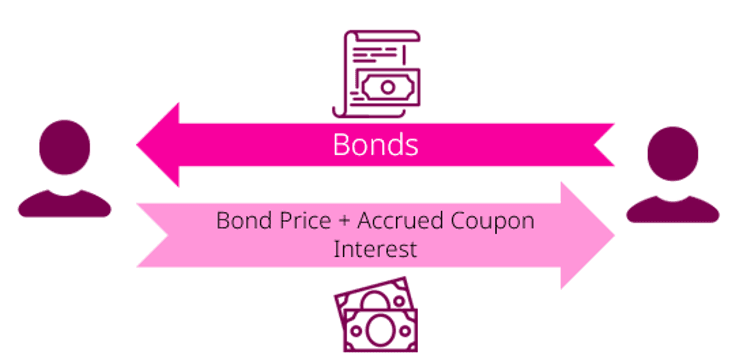
Thus, there is a distinction between the “clean price” of a bond (excluding accrued interest) and the “dirty price”(including accrued interest). When buying, an investor pays the dirty price but receives the full coupon on the next payment date. Effectively, the accrued interest paid upfront is returned with that coupon payment. In this way, both the buyer and seller earn interest income exactly for the period during which they owned the bond, regardless of the coupon period length.
 Thanks to this mechanism, bond trades can occur evenly on any day, and investors’ yields remain fair and proportional to the holding period.
Minimum Piece and Increment
When trading bonds, financial markets set specific rules regarding transaction sizes to ensure orderliness and liquidity. Two key terms describing these rules are Minimum Piece and Increment.
The Minimum Piece is the smallest nominal volume of bonds that can be bought or sold in one transaction. For example, if the minimum lot is one bond with a face value of $1,000, then it is not possible to make a transaction for less than $1,000. This rule prevents extremely small transactions that could be inefficient and distort market prices.
The Increment is the amount by which a trade volume can increase beyond the minimum piece. If the increment is one bond, you can trade one, two, three, or more bonds but not fractional parts like 1.5 bonds. On some markets, the increment may be set in larger blocks (e.g., $100,000 face value), depending on the bond type or trading venue requirements.
Bond Yield
We have already discussed in one of our blogs what yield to maturity is, which is often used to compare bonds and select the optimal investment.
It is important to understand that investors are usually shown the annual yield to maturity to make it easier to compare bonds with different maturities. If the bond matures in less than one year, the actual yield over that period will be roughly proportional to the holding time. For example, if the annual yield to maturity of a bond is around 10%, and an investor holds it for only six months, their yield for that period will be about 5%.
The coupon rate is also expressed as an annual percentage of the face value. Therefore, if a bond has an 8% annual coupon and pays semiannually, the investor will receive 4% of the face value in coupon payments every six months.
Embedded Options
Some bonds are issued with special provisions that allow one of the parties to change the maturity date of the bond. These provisions are called embedded options.
A call option(early redemption right) gives the issuer the right (but not the obligation) to redeem the bond before maturity. The issuer usually exercises this right if market interest rates have declined and it can refinance at a lower cost. For investors, the presence of a call option means the risk that the bond may be redeemed earlier than expected, resulting in lower future income.
A put option(early sell right) gives the investor the right (but not the obligation) to sell the bond back to the issuer at a predetermined price before maturity. This mechanism protects the investor against rising interest rates or deterioration in the issuer’s financial position, as it allows exiting the investment under predetermined conditions.
Thus, embedded call and put options affect the risk and return of bonds: a call reduces the predictability of investor income. In contrast, a put increases investor protection and can make a bond more attractive. Usually, these risks and opportunities are already reflected in yields: bonds with call options offer higher yields, while those with put options offer lower yields.
Amount outstanding
The amount outstanding for bonds refers to the total value of a bond issue that is currently in circulation and has not yet been repaid or redeemed by the issuer. When bonds are initially issued, the amount outstanding equals the total face value issued. Over time, this amount may decrease if the issuer repurchases or redeems part of the bonds early, or it may remain unchanged until the bonds reach maturity.
The amount outstanding is an important metric for investors and analysts because it indicates the size of a bond issue and its potential liquidity in the market. Generally, the larger the amount outstanding, the easier it is for investors to buy and sell the bonds without significantly affecting their market price. It is also used as a reference when comparing the relative importance of different bond issues or evaluating the borrowing levels of an issuer, which can influence credit risk assessment.